New Quantum Detector Makes Terahertz Tech 20x More Efficient
Scientists created a compact detector that captures elusive terahertz radiation 20 times better than previous designs, bringing practical applications in medicine and communications much closer to reality. The breakthrough uses quantum physics and a specially patterned surface to turn hard-to-detect waves into measurable electrical signals.
Scientists just solved a decades-old problem that's been holding back everything from cancer detection to next-generation wireless networks.
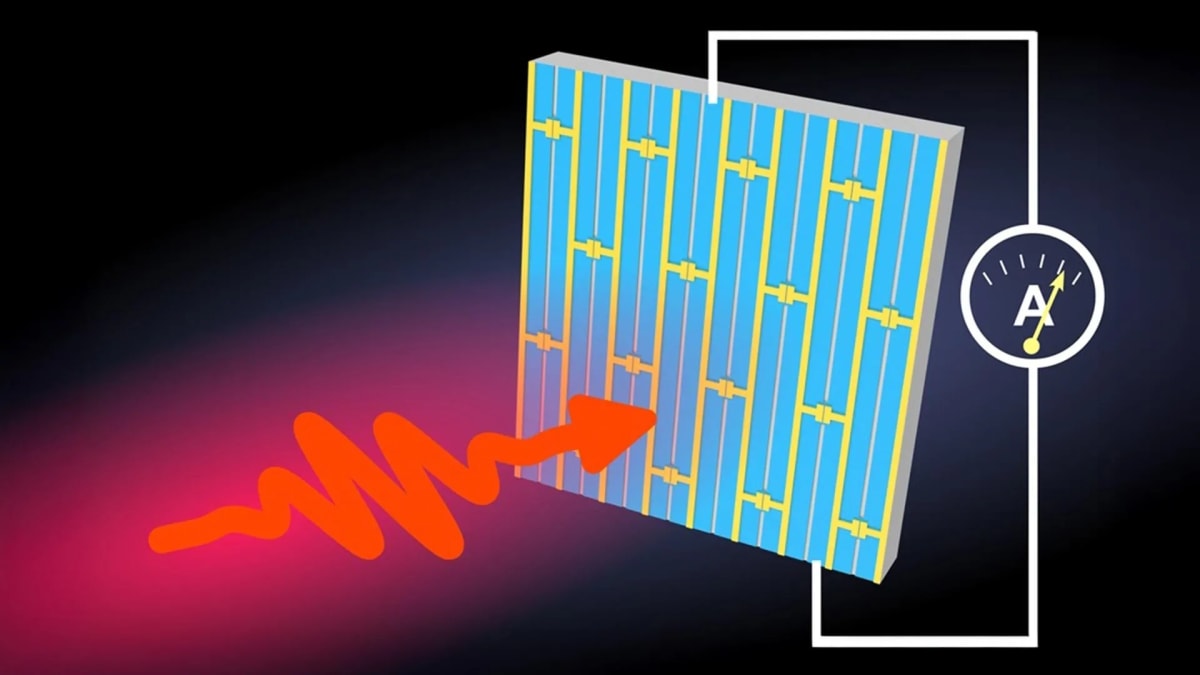
Researchers at the University of Cambridge and Swansea University developed a new detector that captures terahertz radiation with 20 times more efficiency than earlier designs. Terahertz waves sit between microwaves and infrared light on the electromagnetic spectrum, but they've been notoriously difficult to detect without bulky, expensive equipment that needs extreme cooling.
The new device combines quantum physics with a specially engineered surface called a metasurface. This patterned structure acts like a funnel, concentrating incoming terahertz waves into tiny active regions where detection happens. Think of it as focusing scattered sunlight through a magnifying glass, except the "glass" is built directly into the detector itself.
The team embedded individual detection elements right where the electric field becomes strongest. This design choice eliminated the main weakness of earlier detectors, which could only capture a small fraction of incoming radiation through individual antenna elements.
Lead researcher Wladislaw Michailow explained that building the detector and light-collection system as one integrated unit, rather than separate components, made the crucial difference. The approach boosted detection sensitivity far beyond what connecting multiple devices in parallel could achieve.
The detector works through something called the in-plane photoelectric effect. Incoming terahertz photons energize electrons trapped in a two-dimensional layer, and those electrons cross a carefully designed barrier to produce measurable electrical current. Unlike conventional detectors, this process doesn't require photons to reach a minimum energy threshold, making it more sensitive.
The team cooled the device to 10 Kelvin and tested it with radiation near 1.9 terahertz. The detector produced clear electrical signals matching the pattern of incoming waves, achieving 2.1 percent external quantum efficiency.
The Ripple Effect
This breakthrough could finally unlock terahertz technology's enormous potential across multiple fields. Medical imaging could become safer and more detailed, since terahertz waves can see through many materials without the cancer risks of X-rays. Communications networks could handle far more data. Scientific instruments could probe materials and biological processes in entirely new ways.
The detector uses manufacturing techniques already common in making computer chips, meaning it could be mass-produced without inventing new factory processes. Because the metasurface itself concentrates radiation, the device doesn't need external focusing components like silicon lenses, making it simpler and cheaper to build.
The device also operates with zero voltage bias, which reduces unwanted electrical noise and improves accuracy. This makes it practical for real-world applications where reliability matters as much as sensitivity.
The technology turns what was once a frustrating gap in our ability to see the electromagnetic spectrum into an accessible window with countless applications.
Based on reporting by Science Daily
This story was written by BrightWire based on verified news reports.
Spread the positivity!
Share this good news with someone who needs it