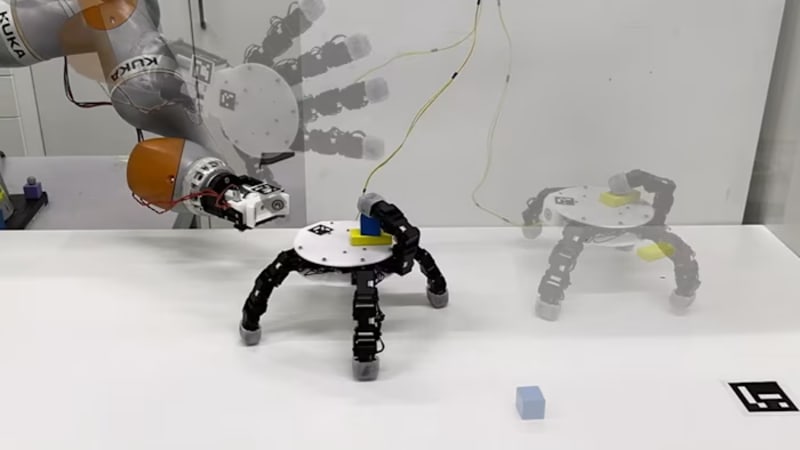
Robot Hand Detaches, Crawls, and Grabs Objects on Its Own
Scientists created a six-fingered robotic hand that can undock from its arm, crawl independently, and carry multiple objects at once. The breakthrough could revolutionize industrial inspections and repairs in tight spaces humans can't reach.
A robotic hand that crawls like a spider and grabs objects from every angle just became reality, and it's designed to help us in ways human hands never could.
Researchers at Switzerland's EPFL have developed a six-fingered robot hand that detaches from its host arm, walks on its fingers to retrieve objects, and reattaches itself when finished. Unlike human hands that rely on thumbs for gripping, each finger on this robot can oppose any other finger, creating multiple versatile grips at once.
The hand's superpower isn't just its independence. It can grasp objects from both its front and back sides, carry multiple items simultaneously, and perform tasks that would normally require two human hands, like unscrewing a bottle cap while holding the bottle.
Lead researcher Xiao Gao says the hand is built to overcome human anatomical limitations. "The goal is to design a dual-mode robot that can go beyond human hand dexterity and improve capabilities," he explains.
The real-world applications extend far beyond science fiction thrills. Industrial facilities could deploy these hands for inspections inside pipes and machinery where space is too tight for humans or traditional robots. Imagine a maintenance robot that sends its hand crawling through narrow passages to retrieve dropped tools or fix hard-to-reach equipment.
The hand could work alongside robot dogs like Boston Dynamics' Spot, which are already patrolling industrial sites. Together, they'd create a dynamic team capable of covering large areas, identifying problems, and performing simple repairs without human intervention in dangerous environments.
Why This Inspires
This innovation represents a fundamental shift in how we think about robotic assistance. Rather than simply mimicking human anatomy, researchers are reimagining what's possible when we move beyond biological constraints.
Oxford Robotics Institute's Digby Chappell calls the research "fun and provocative," noting it's "definitely pushing the boundary of what we think robot hands should be able to do." He sees potential applications in prosthetics, where future artificial limbs might adopt similar versatile designs.
The hand transforms our understanding of robotic versatility, proving that robots don't need to choose between mobility and manipulation. They can excel at both, opening doors to safer industrial operations and more efficient maintenance systems.
One crawling hand today might mean countless workers staying safe tomorrow, far from hazardous spaces that machines can now navigate alone.
More Images


Based on reporting by Google News - Technology
This story was written by BrightWire based on verified news reports.
Spread the positivity!
Share this good news with someone who needs it