Scientists Boost Heat Flow 4X With Tiny Gold Structures
Researchers used microscopic gold patterns to supercharge heat transfer at the nanoscale, achieving four times more energy flow than conventional systems. The breakthrough could revolutionize computer chip cooling and unlock new energy technologies.
Scientists just figured out how to make heat move four times faster across impossibly tiny spaces, and it could transform everything from your laptop to future power grids.
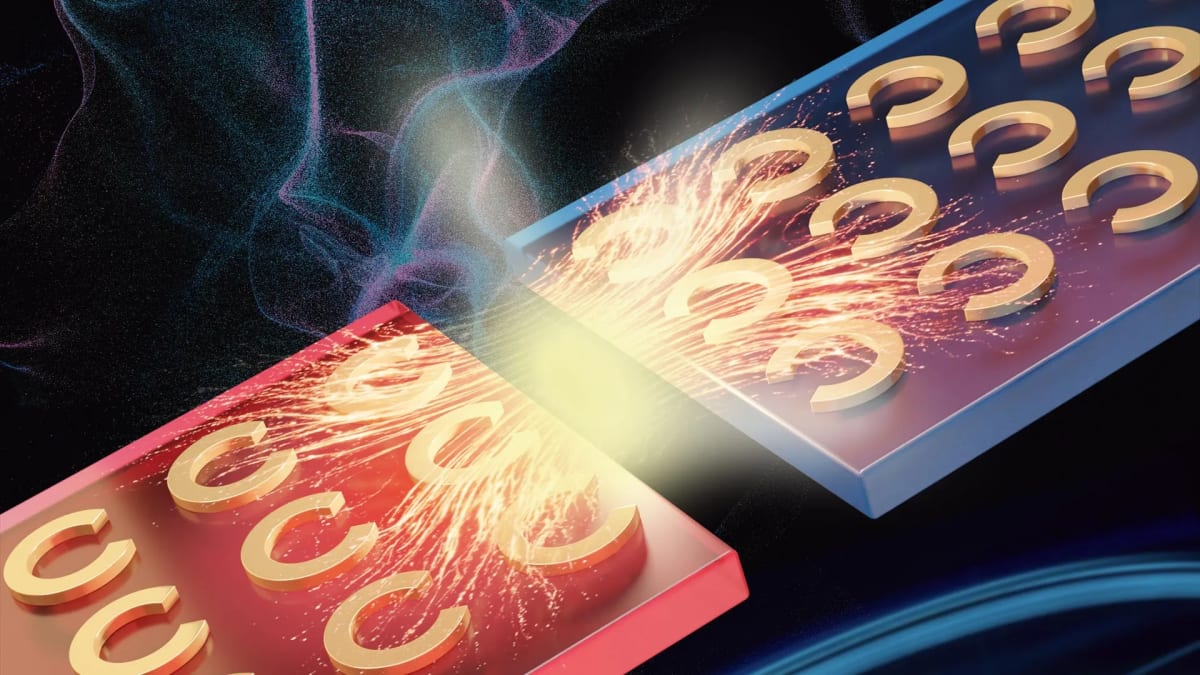
Researchers at Carnegie Mellon University teamed up with Stanford and Purdue to prove that heat doesn't have to follow the usual rules when you engineer it at the nanoscale. They built microscopic gold structures on thin membranes and positioned them face to face across a gap smaller than a human hair's width.
The results were stunning. Heat flowed across that tiny gap at rates far beyond what traditional physics predicted for larger distances. The secret wasn't just creating more pathways for heat to travel.
The gold patterns created something called a resonance effect by interacting with natural energy waves in the material. PhD student Zexiao Wang explained it as a cooperative dance where the structures and the material's energy waves amplify each other, letting thermal energy move more freely and efficiently.
The team's work, published in Nature, provides the first strong experimental evidence that heat transfer can be intentionally engineered and dramatically enhanced using metamaterials. These are specially designed materials with microscopic repeating patterns that interact with energy in highly controlled ways.
Professor Sheng Shen, who led the research, emphasized that metamaterials work differently than conventional materials. Instead of relying on what nature provides, engineers can design precise patterns that interact with energy exactly how they want.
The Ripple Effect
This discovery arrives at a crucial moment. As electronics shrink and pack more power into smaller spaces, removing excess heat has become one of the biggest engineering headaches. Better heat control could lead to computers that run faster without overheating.
Energy systems could benefit even more. Thermophotovoltaic devices that convert heat directly into electricity could become far more efficient with enhanced thermal radiation transfer. That means turning waste heat from factories or power plants into usable energy.
Environmental monitoring and security systems that rely on infrared sensing could get sharper signals and better detection. The potential applications span from climate science to national defense.
The experiments happened under controlled lab conditions and remain limited to nanoscale systems for now. But Shen sees bigger possibilities ahead: if heat can be engineered with the same precision as electricity or light, it opens the door to technologies built not just to withstand heat, but to harness it.
The breakthrough turns heat from a problem we manage into a resource we can control and direct wherever it's needed most.
Based on reporting by Science Daily
This story was written by BrightWire based on verified news reports.
Spread the positivity!
Share this good news with someone who needs it