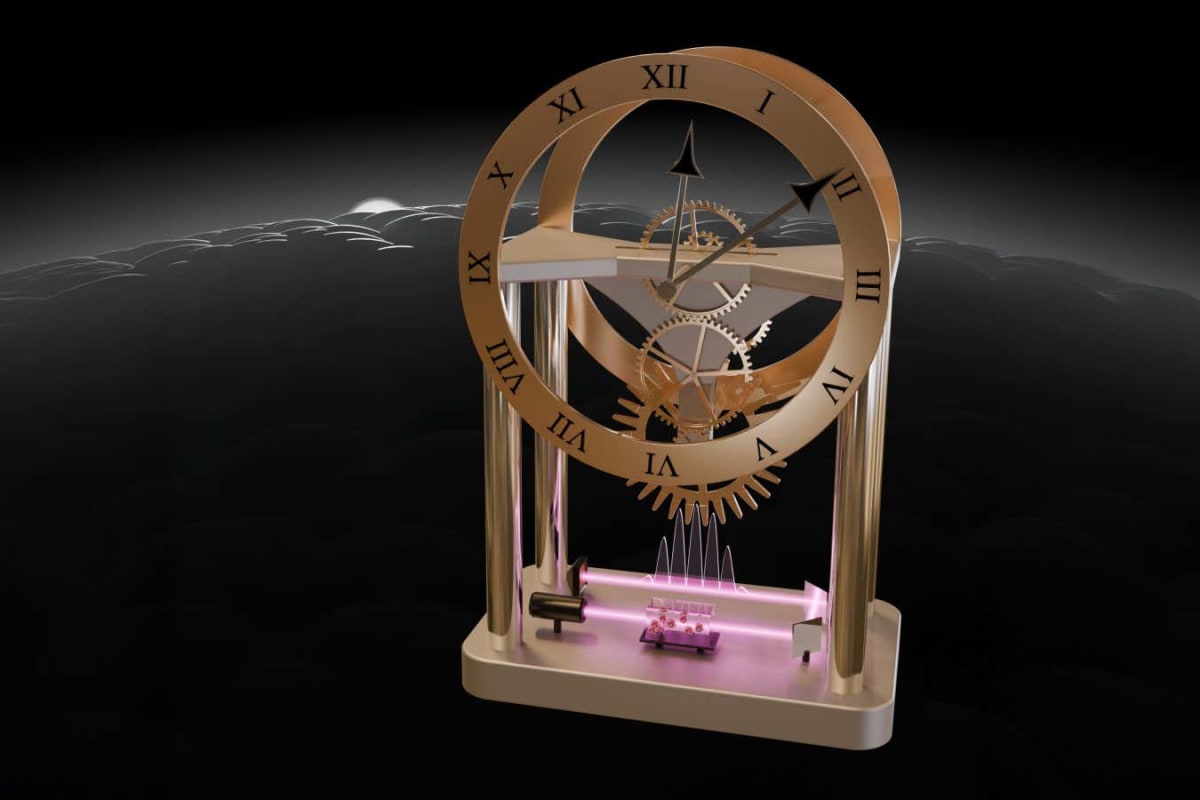
Scientists Build First Working Nuclear Clock in Vienna
After 20 years of research, scientists have created the world's first working nuclear clock that could revolutionize timekeeping and help discover new physics. The breakthrough device works at room temperature and is already being used to hunt for dark matter.
Scientists in Vienna just achieved something researchers have been dreaming about for two decades: a clock so precise it could keep perfect time for hundreds of billions of years.
Thorsten Schumm and his team at Vienna University of Technology built the first working nuclear clock, a device that uses the vibrations of atomic nuclei instead of electrons to measure time. "It's the culmination of 15 to 20 years of research," says Schumm. "Very few researchers actually see their dream become true."
Today's best atomic clocks lose only a few seconds every billion years, which sounds impressive. But nuclear clocks could theoretically stay accurate for longer than the universe has existed.
The secret ingredient is radioactive thorium. Most atomic nuclei need more energy to activate than even the strongest lasers can provide, but thorium can be excited with relatively modest energy levels. The team embedded thorium in a calcium fluoride crystal and shone an ultraviolet laser through it, creating a ticking mechanism similar to a grandfather clock's pendulum.
The breakthrough came in the feedback system. The laser periodically switches between two frequencies just above and below thorium's known nuclear frequency. If both frequencies are absorbed equally, the clock is perfectly tuned. If not, the system automatically adjusts.
Right now, the nuclear clock loses tens of seconds every billion years, which means it's not yet as stable as the best atomic clocks. But this is just a proof of concept. The team hasn't even fine tuned it with the best available lasers and electronics yet.
What impressed the team most was how reliably it worked. "The system ran overnight and for 24 hours without user intervention," says team member Ekkehard Peik. "This is something that has not been achieved so rapidly with other optical clocks."
The Bright Side
Unlike atomic clocks that need extreme cooling and vacuum conditions, the nuclear clock works at room temperature. "It's really the most simple thing you can imagine," says Schumm. This simplicity means it could be miniaturized and used in satellite tests of relativity and other experiments that need portable precision.
The nuclear clock is already proving useful beyond timekeeping. Because the nucleus sits protected from the chaotic electromagnetic environment of electrons, it can detect subtle changes that atomic clocks miss. The team used this sensitivity to rule out certain types of dark matter particles that could permeate our universe.
Think of it like measuring how metal expands with heat. The longer your measuring stick, the easier it is to see tiny changes. Thorium's extremely high nuclear frequency gives scientists a much longer stick to work with.
"While the current performance is considerably below the current state of the art, we can expect orders of magnitude improvement in the near future," says Eric Hudson at UCLA.
The age of nuclear timekeeping has officially begun.
More Images

Based on reporting by New Scientist
This story was written by BrightWire based on verified news reports.
Spread the positivity!
Share this good news with someone who needs it