Scientists Discover New Type of Planet With Sulfur Ocean
Astronomers have found a completely new kind of world 35 light years away: a planet with an ocean of molten rock thousands of kilometers deep that traps massive amounts of sulfur inside. The discovery suggests our galaxy contains far more diverse planets than scientists ever imagined.
Scientists have discovered something they've never seen before: a planet that doesn't fit any known category, revealing just how wonderfully weird our universe really is.
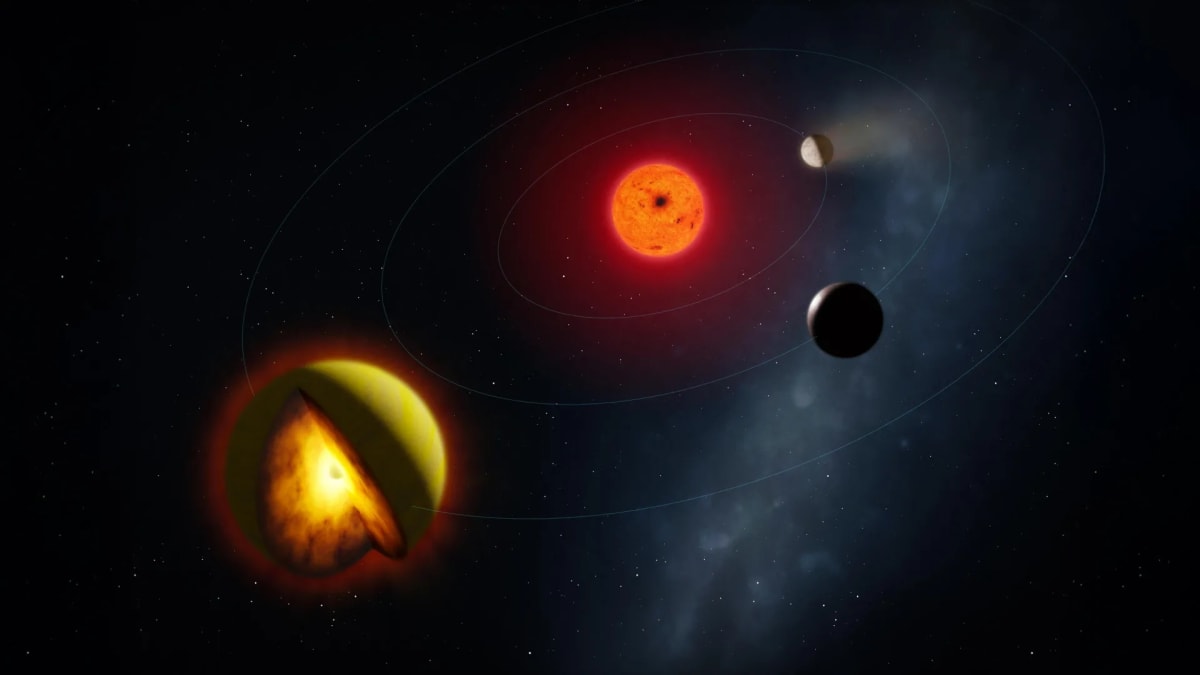
The world, called L 98-59 d, orbits a small red star about 35 light years from Earth. When researchers at the University of Oxford pointed the James Webb Space Telescope at it, they found something puzzling: a planet 1.6 times Earth's size with surprisingly low density and an atmosphere thick with sulfur gases.
At first, scientists assumed it must be either a rocky planet with hydrogen atmosphere or a water world covered in deep oceans. But neither explanation matched the data they were seeing.
Using advanced computer simulations spanning nearly five billion years, the research team traced the planet's evolution from birth to present day. What they discovered beneath its surface amazed them: a vast ocean of molten rock extending thousands of kilometers deep, constantly cycling sulfur between the interior and atmosphere.
This enormous magma reservoir acts like a massive storage system, trapping and releasing gases over billions of years. The combination creates a thick hydrogen atmosphere loaded with hydrogen sulfide and other sulfur compounds that would normally be stripped away by radiation from the host star.
Lead researcher Dr. Harrison Nicholls explained that current categories for classifying small planets may be too simple. While this molten world is unlikely to support life, it shows just how diverse planetary systems across our galaxy really are.
The discovery opens an exciting question: if scientists found one sulfur dominated planet with a long lasting magma ocean, how many more are out there waiting to be discovered?
Why This Inspires
This breakthrough shows how much we're still learning about the cosmos. Every time scientists think they understand how planets work, the universe surprises them with something completely new.
The research also offers a window into Earth's own past. Scientists believe all rocky planets, including Earth and Mars, started as magma oceans billions of years ago. Studying these environments on distant worlds helps us understand our own planet's earliest days.
Professor Raymond Pierrehumbert noted that computer models now allow scientists to reconstruct the hidden interior of planets they'll never visit. Although astronomers can only measure size, mass and atmospheric composition from afar, they can piece together the deep history of these alien worlds.
The team plans to use machine learning to analyze data from upcoming missions, mapping the full diversity of planets beyond our Solar System. By understanding how different types of planets form and evolve, scientists hope to identify which worlds might be capable of supporting life.
The universe just got a little more interesting, and a lot more diverse than we thought.
Based on reporting by Science Daily
This story was written by BrightWire based on verified news reports.
Spread the positivity!
Share this good news with someone who needs it