Scientists Find Fast Radio Bursts Come From Star Pairs
A mysterious cosmic flash just revealed it has a companion star. This discovery rewrites what we know about where the universe's most powerful radio signals come from.
Astronomers have discovered that some of the universe's most mysterious signals aren't coming from lonely stars after all. They're coming from cosmic couples.
Fast radio bursts are powerful flashes of radio waves that last just milliseconds but release incredible amounts of energy. Scientists have been trying to figure out where they come from since discovering them years ago.
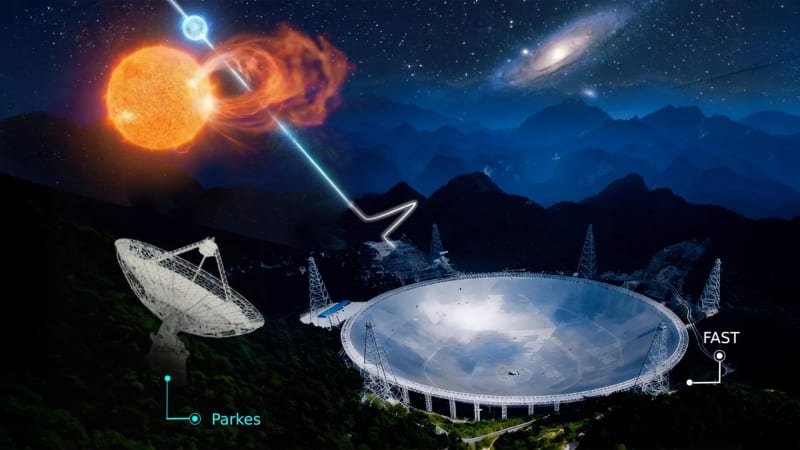
Now an international team including researchers from the University of Hong Kong has found the clearest proof yet that at least some of these signals come from binary star systems, where two stars orbit each other. The discovery happened while studying a repeating burst located 2.5 billion light years from Earth.
The breakthrough came from China's massive Five-hundred-meter Aperture Spherical Telescope, nicknamed the "China Sky Eye." After nearly 20 months of watching one particular burst source called FRB 220529A, researchers spotted something extraordinary.
The radio waves suddenly showed a dramatic shift in their polarization properties. This rare event, called an RM flare, meant something had temporarily changed the space around the burst source.
The most likely explanation? A companion star had just erupted, shooting out a massive cloud of magnetized plasma. As this cloud passed between the burst source and Earth, it left an unmistakable signature in the radio signal.
"This finding provides a definitive clue to the origin of at least some repeating FRBs," said Professor Bing Zhang from HKU. The evidence points to a binary system containing a magnetar (a neutron star with an extremely strong magnetic field) paired with a star similar to our Sun.
The Bright Side
This discovery opens up exciting new ways to understand these cosmic mysteries. Before, scientists assumed most fast radio bursts came from isolated stars in empty space, making them incredibly difficult to study and understand.
Now we know that companion stars can leave detectable fingerprints in the signals. That means astronomers have a new tool for investigating these distant cosmic events and learning about the extreme environments that produce them.
The finding also supports a larger theory that all fast radio bursts might come from magnetars, while interactions with companion stars help create the conditions for some sources to repeat more frequently. Understanding these patterns could help solve one of astronomy's biggest recent puzzles.
"This discovery was made possible by persevering observations using the world's best telescopes," said lead author Professor Xuanfeng Wu. The team plans to continue monitoring other repeating sources to see if more reveal hidden companions.
The universe just got a little less lonely, and a lot more interesting.
Based on reporting by Science Daily
This story was written by BrightWire based on verified news reports.
Spread the positivity!
Share this good news with someone who needs it