
Scientists Find Hidden Order in Superconductor Mystery
Physicists discovered hidden magnetic patterns inside the pseudogap, a puzzling state that appears right before materials become superconductors. This breakthrough brings us closer to engineering superconductors that work at higher temperatures, potentially transforming power grids and quantum computers.
Scientists just solved a piece of one of physics' most exciting puzzles, and it could eventually mean electricity that flows without losing any energy.
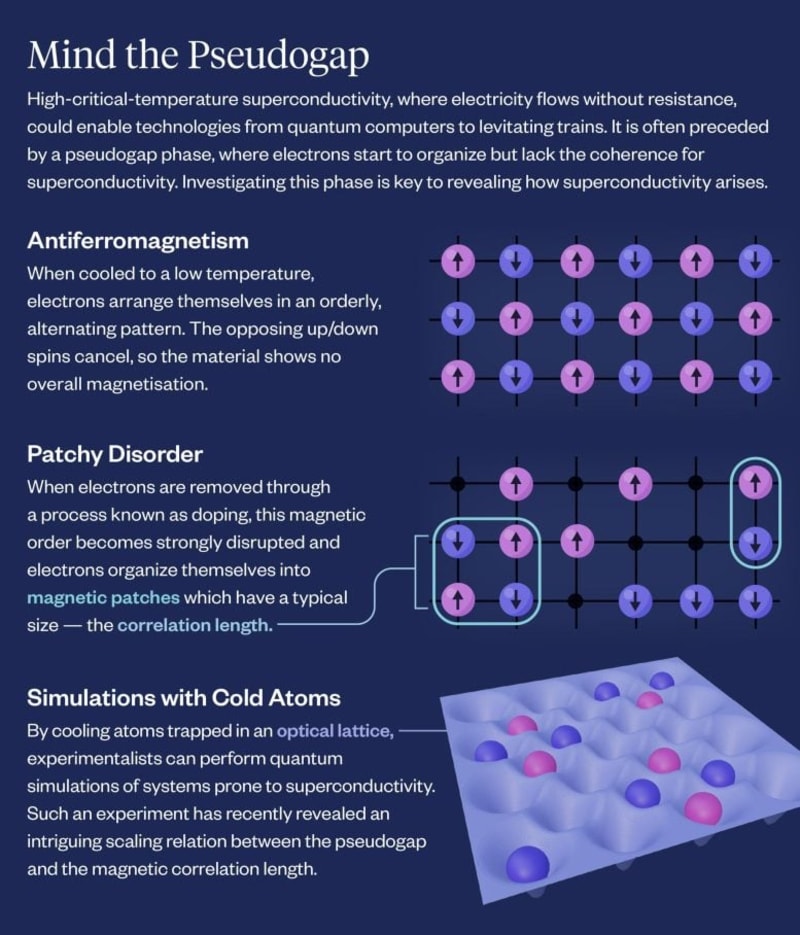
Researchers at the Max Planck Institute in Germany teamed up with theorists at the Simons Foundation's Flatiron Institute to study the pseudogap, a mysterious state that materials enter just before becoming superconductors. Inside what looked like random chaos, they found something remarkable: hidden magnetic order that persists even when the material seems completely disorganized.
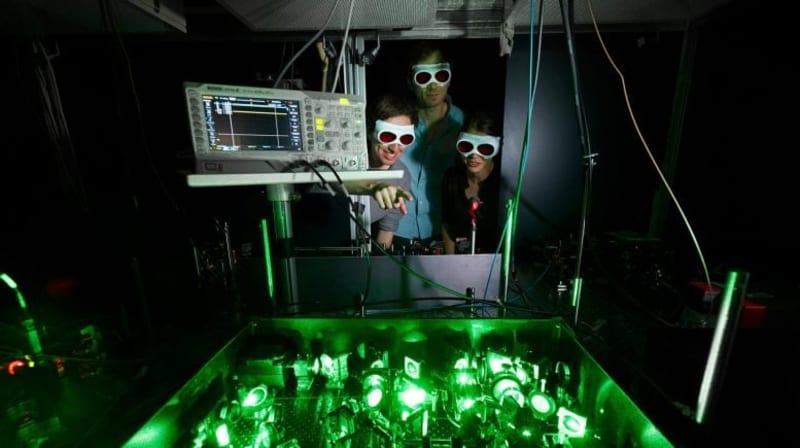
The team used a quantum simulator cooled to just billionths of a degree above absolute zero, trapping lithium atoms in a grid made of laser light. This setup let them recreate conditions impossible to achieve with real materials and watch individual atoms interact.
Using a quantum gas microscope, they captured more than 35,000 detailed images showing how electrons affect their neighbors' magnetic orientations. What they saw surprised everyone: magnetic correlations follow a single universal pattern tied directly to the temperature where the pseudogap emerges.
The discovery matters because superconductivity could revolutionize technology, from loss-free power transmission to faster quantum computers. But scientists still don't fully understand how it works, especially in materials that superconduct at relatively high temperatures.
For decades, researchers thought that removing electrons from these materials completely destroyed their magnetic organization. This study proves otherwise. Even when the system looks disordered, subtle structures remain, with a single missing electron disrupting magnetic order across a surprisingly wide area.
The team also captured something only a few labs worldwide can measure: correlations between up to five particles at once, revealing that electrons organize into complex multiparticle groups rather than simple pairs.
Why This Inspires
This research represents the best kind of scientific collaboration, with experimentalists and theorists working together across continents to crack a problem that has stumped physicists for years. The theoretical predictions made at the Flatiron Institute in 2024 guided the experimental work, which then confirmed and expanded those predictions.
Lead author Thomas Chalopin explains the bigger picture: "By revealing the hidden magnetic order in the pseudogap, we are uncovering one of the mechanisms that may ultimately be related to superconductivity." Director Antoine Georges adds that it's remarkable quantum simulators can now reach temperatures where these intricate phenomena appear.
Every step toward understanding superconductivity brings us closer to materials that could carry electricity across cities without waste, make magnetic levitation trains practical, or enable quantum computers powerful enough to solve problems beyond today's technology.
The findings appeared in the Proceedings of the National Academy of Sciences in January 2025, offering other researchers a new standard for testing their own models and theories.
Sometimes the most important discoveries come from finding order in what everyone else saw as chaos.
More Images

Based on reporting by Google News - Tech Breakthrough
This story was written by BrightWire based on verified news reports.
Spread the positivity!
Share this good news with someone who needs it