Scientists Map Fly Brain, Find Surprise About Intelligence
Researchers completed the first full brain-to-body wiring map of a fruit fly and discovered something unexpected. Complex behaviors might emerge from local teamwork between neurons rather than a single control center in the brain.
Scientists just completed an extraordinary map showing every neural connection in a fruit fly's central nervous system, and what they found challenges how we think about intelligence itself.
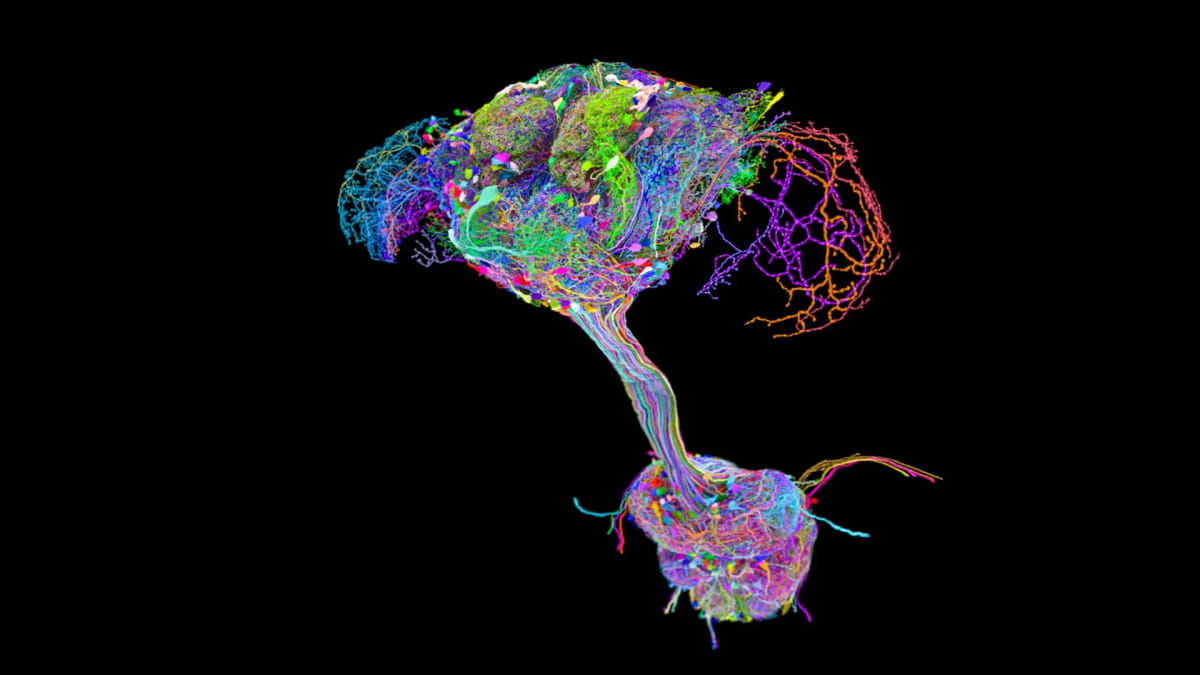
A large international team led by Harvard Medical School and Princeton University has mapped all 160,000 neurons in an adult fruit fly, creating the first complete picture of how a brain connects to a body. The map, called a connectome, reveals something surprising about how complex behaviors happen.
Instead of finding one central command center directing everything from the brain, researchers discovered that many behaviors appear to be controlled by local neural circuits in the relevant body parts. It's like finding out that a company runs better through team decisions rather than one boss calling all the shots.
"We can see all of the neurons and their connections as a complete unit for the first time," said Rachel Wilson, a professor at Harvard Medical School and study co-author. The team combined a previously published fruit fly brain map with a new map of the nerve cord, which is the fly's version of a spinal cord.
The project required slicing one fruit fly into thousands of extremely thin sections, capturing millions of images through electron microscopy, and using AI tools to assemble them into a unified 3D map. The result shows how each neuron connects with others at the level of individual synapses.
Why does a fruit fly matter? Despite having a tiny nervous system compared to humans, fruit flies can navigate, interact socially, learn, and react to sensory signals. Understanding how their simpler system works gives scientists clues about the core rules that govern all nervous systems, including ours.
The complete map is now freely available online for researchers worldwide. Scientists can use it to develop new hypotheses about how sensation leads to action, how information flows through a nervous system, and how intelligence emerges from neural networks.
Why This Inspires
This breakthrough shows how scientific collaboration can unlock mysteries about consciousness and behavior that seemed impossible to solve just years ago. The discovery that intelligence might emerge from distributed teamwork rather than centralized control mirrors what we're learning about effective human organizations and communities.
The findings could eventually help researchers understand movement disorders, brain injuries, and neurological conditions in humans. More importantly, they remind us that complexity and intelligence don't always require top-down control.
The work received support from the BRAIN Initiative, National Institutes of Health, and National Science Foundation, representing years of patient scientific work finally coming together.
A tiny fly just taught us something profound about how brains, bodies, and maybe even societies work best together.
Based on reporting by Science Daily
This story was written by BrightWire based on verified news reports.
Spread the positivity!
Share this good news with someone who needs it