Scientists May Have Found the Glueball After Decades
Chinese physicists have spotted what could be the first glueball, a bizarre particle predicted by physics but never confirmed until now. This discovery validates decades of theoretical work about how the universe's strongest force operates.
After years of sifting through mountains of collision data, Chinese scientists believe they've finally spotted one of physics' most elusive predictions: the glueball.
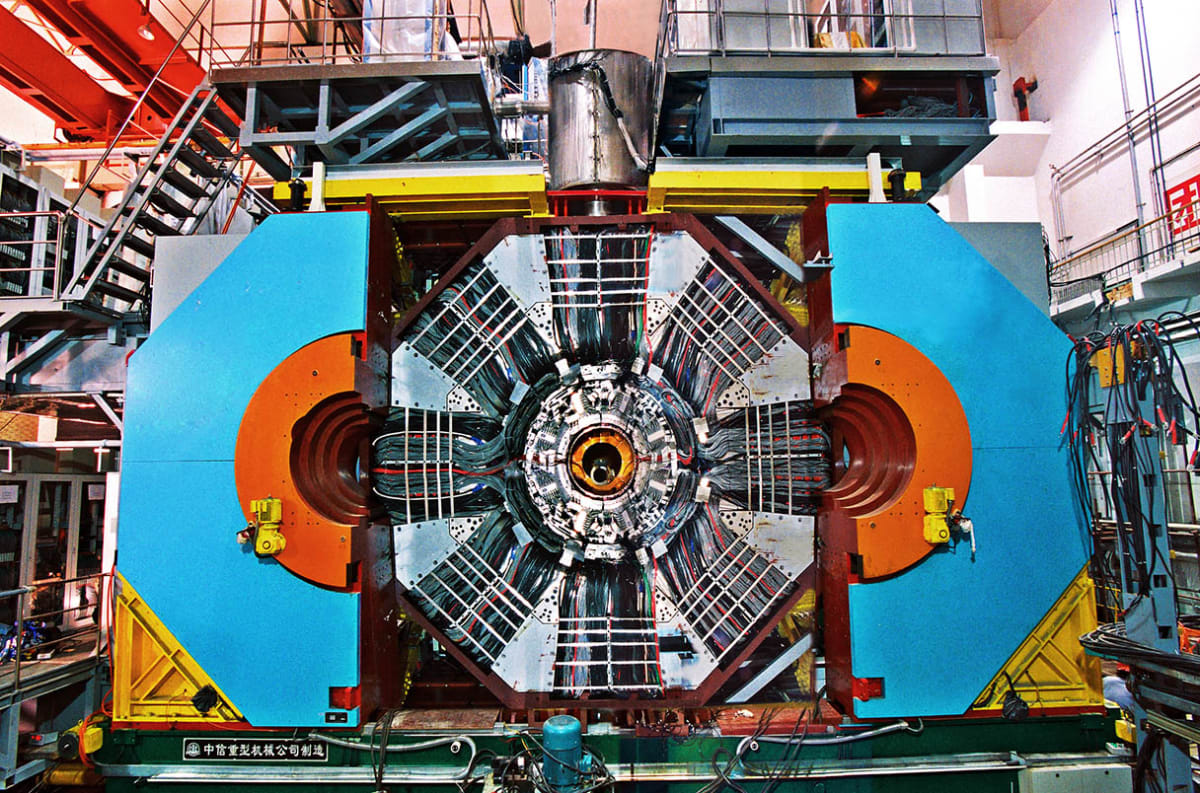
The Beijing Electron-Positron Collider II detected a particle called X(2370) that matches what physicists have been hunting for decades. A glueball is unlike anything else in nature because it contains no quarks, the tiny bits that make up protons and neutrons.
Instead, this odd particle is made entirely of gluons, the force-carrying particles that hold atomic nuclei together. Imagine a proton without its quarks, just the sticky force particles tangled up together, and you've got a glueball.
The discovery matters because it confirms what the Standard Model of physics predicted but couldn't prove. Scientists have theorized these particles should exist wherever the strong nuclear force operates, but they're nearly impossible to catch because they decay almost instantly into other particles called pions.
The Beijing team spent months analyzing terabytes of data from their collider to make sure they were seeing the real thing. Glueballs likely never form naturally, even in the hottest cosmic events, because quarks almost always mix into the soup.
Why This Inspires
This discovery shows the power of patient, careful science. The research team didn't rush to announce their findings but took the time to verify what they were seeing, sorting through massive amounts of data to separate signal from noise.
The glueball won't change daily life or lead to new technology. Its lifespan is far too short, and it only exists in extreme, human-made environments. But it proves that our understanding of the universe's fundamental forces is on the right track.
Every confirmed prediction strengthens the foundation for future discoveries. When scientists verify what they expected to find, it means the tools and theories they're using to explore the unknown actually work.
And there's always the exciting possibility that further analysis could reveal X(2370) isn't a glueball at all, but something completely unexpected. Either way, another piece of the cosmic puzzle has clicked into place.
More Images



Based on reporting by Google: scientific discovery
This story was written by BrightWire based on verified news reports.
Spread the positivity!
Share this good news with someone who needs it