Scientists Prove 85-Year Theory, Unlock Dark Matter Hunt
Chinese researchers just confirmed a physics prediction from 1939 that could finally help us detect the invisible substance making up most of our universe. The breakthrough gives scientists a powerful new tool to search for dark matter particles that were previously impossible to find.
After 85 years of being just an idea on paper, a prediction about how atoms behave has finally been proven real, and it might unlock one of the biggest mysteries in science.
A team of Chinese physicists just captured the first direct evidence of something called the Migdal effect. Back in 1939, Soviet scientist Arkady Migdal predicted that when an atom's nucleus gets bumped hard enough, the sudden jolt can kick out one of its orbiting electrons.
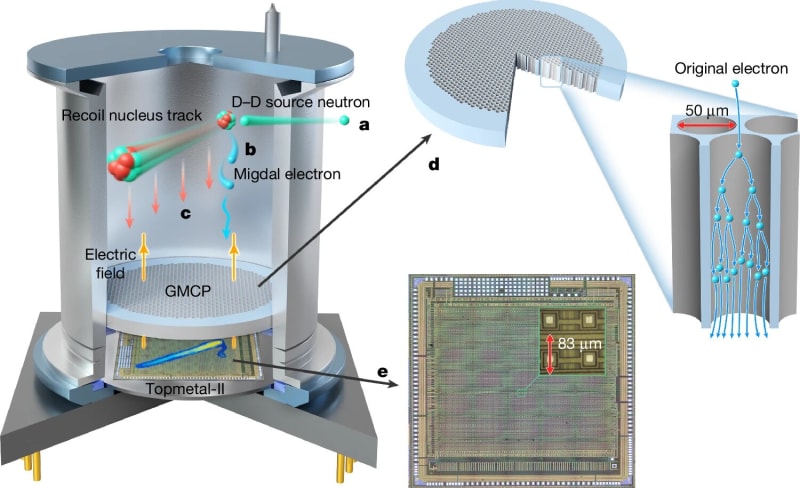
Scientists have tried for decades to prove this actually happens, but the effect is incredibly tiny and easily drowned out by background radiation. This team succeeded where others failed by building what's essentially an atomic camera, a high precision gas detector paired with a custom microchip sensitive enough to track a single atom and its ejected electron.
They bombarded gas molecules with neutrons and analyzed over 800,000 events. Out of all that data, they found six crystal clear signals showing the Migdal effect's signature: two particle tracks emerging from the exact same point, one from the recoiling nucleus and one from the ejected electron.
The discovery met the five sigma threshold, the gold standard that physicists use to confirm they've found something real. "Directly observing the Migdal effect in nuclear experiments has been a long standing and widely recognized challenge," said Haibo Yu, a physics professor at UC Riverside who wasn't involved in the study.
The Ripple Effect
This isn't just about confirming old theory. It opens a door that's been locked for years in the search for dark matter, the invisible stuff that makes up roughly 85% of the universe but has never been directly detected.
For decades, scientists hunted for heavy dark matter particles called WIMPs using massive detectors. Those searches came up empty, so attention has shifted to much lighter dark matter particles that are even harder to spot.
Here's the problem those lighter particles solve: when a featherweight dark matter particle hits an atom, the bump is too gentle for normal detectors to notice. But if that collision triggers the Migdal effect and kicks out an electron, suddenly you have something detectable.
"With the Migdal effect, once an electron is ejected, our detector can, in theory, capture 100% of its energy," said Yangheng Zheng, who co led the research. The process turns an invisible tap into a signal scientists can actually measure.
The team published their findings in the journal Nature and is already planning next steps. They want to test the effect using different elements, which will help optimize detectors for hunting the lightest dark matter particles.
After nearly a century of waiting, we finally have proof that this atomic trick is real, and a powerful new way to search for the invisible universe all around us.
More Images
Based on reporting by Phys.org
This story was written by BrightWire based on verified news reports.
Spread the positivity!
Share this good news with someone who needs it