Webb Telescope Maps Jupiter's Moon Auroras for First Time
The James Webb Space Telescope just captured something never seen before: the glowing auroral footprints of Jupiter's moons Io and Europa. These stunning images reveal how electrons crash into Jupiter's atmosphere, opening new windows into planetary science.
Scientists just got their first detailed look at one of the solar system's most beautiful phenomena, and it's revealing secrets about how planets and moons interact.
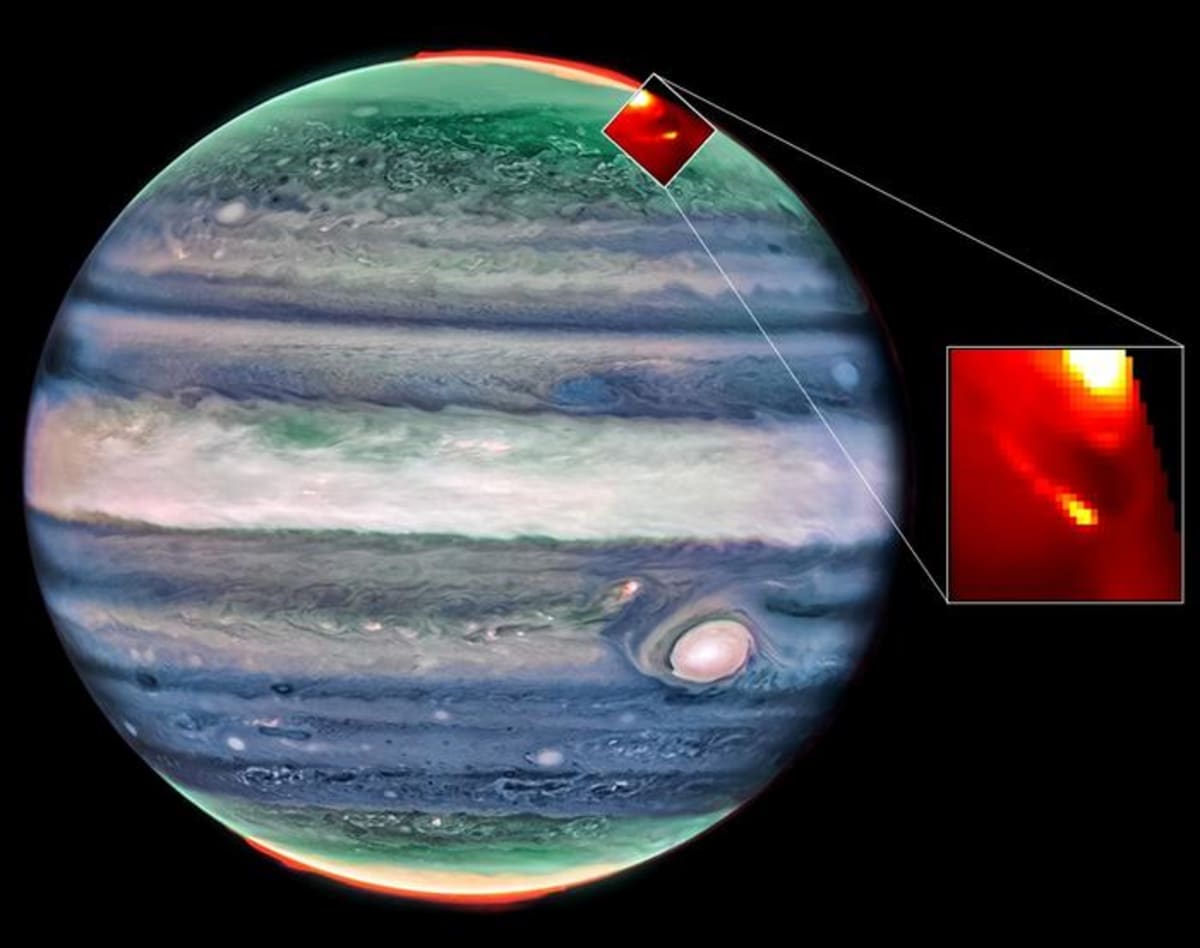
The James Webb Space Telescope captured spectral measurements of the auroral footprints left by Jupiter's moons Io and Europa. These glowing trails appear where Jupiter's powerful magnetic field connects with its moons, creating bright spots in the planet's atmosphere.
Think of it like cosmic breadcrumbs. As Io and Europa orbit Jupiter, they leave behind glowing signatures that scientists can now study in unprecedented detail for the first time.
The measurements revealed something unexpected: extreme changes in the physical properties within Io's auroral footprint. These variations likely happen when electrons from the magnetic connection crash into the top layers of Jupiter's atmosphere, creating a spectacular light show visible from nearly half a billion miles away.
Io, the most volcanically active body in our solar system, and Europa, with its vast underground ocean, have always fascinated scientists. Now researchers can see exactly how these moons interact with their giant parent planet in real time.
Why This Inspires
This discovery represents more than just pretty pictures from space. Webb's ability to capture spectral data means scientists can now understand the chemistry and physics happening in these auroral footprints, something impossible before this telescope launched.
The technology that makes these observations possible didn't exist a few years ago. Webb's Near Infrared Camera and spectrograph can detect details that previous telescopes simply couldn't see, turning what looked like simple bright spots into complex laboratories of planetary physics.
These observations could help scientists understand magnetic interactions throughout the universe, from distant exoplanets to our own solar system. Every new measurement adds another piece to the puzzle of how planets, moons, and magnetic fields work together.
The Webb telescope continues proving its worth as humanity's most powerful window into space, revealing wonders that were invisible to us just months ago.
Based on reporting by Google: James Webb telescope
This story was written by BrightWire based on verified news reports.
Spread the positivity!
Share this good news with someone who needs it