Student Finds Lost Mayan City on Google Page 16
A doctoral student discovered a massive Mayan metropolis without leaving his desk, proving that ancient cities might be hiding in plain sight within forgotten digital archives. The city once housed up to 50,000 people and was found using laser mapping data that had been publicly available all along.
Luke Auld-Thomas was deep into page 16 of a Google search when he stumbled upon something extraordinary: a lost Mayan city that had been waiting centuries to be found.
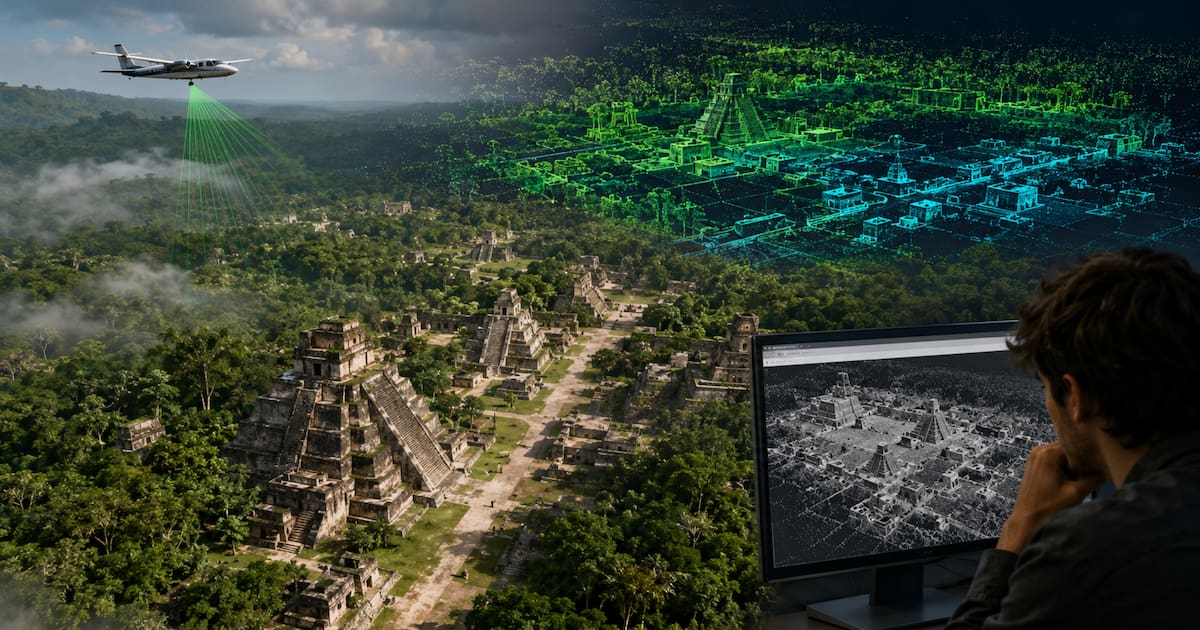
The Tulane University doctoral student wasn't digging through jungle ruins. He was clicking through publicly available LiDAR data, a laser mapping technology that can see through forest canopy to reveal what lies beneath. Hidden in an environmental survey from Campeche, Mexico, he found the outline of pyramids, plazas, ball courts, and thousands of structures forming a complete ancient metropolis.
The team named it Valeriana. Between 750 and 850 A.D., this city likely served as a regional capital with a population between 30,000 and 50,000 people. That makes it nearly as dense as Calakmul, the largest known Mayan site in Latin America.
What makes this discovery remarkable is that the data was just sitting there. A Mexican environmental organization had flown over the site years ago to monitor ecosystems, never realizing their lasers were mapping a lost civilization. The information was public, searchable, waiting for someone curious enough to look.
The researchers identified more than 6,674 buildings across the site. No archaeologist has physically visited Valeriana yet because it remains completely covered by jungle. For now, it exists only as points of light on a digital map, a ghost city preserved in laser scans.
Why This Inspires
This discovery reminds us that major breakthroughs don't always require massive budgets or expeditions to remote locations. Sometimes they just need fresh eyes looking at existing information in new ways.
LiDAR technology has been quietly rewriting ancient history for over a decade. It revealed hidden urban networks in Cambodia's Angkor region in 2013 and uncovered more than 60,000 structures in Guatemala's jungle in 2018. The technology lets researchers explore in hours what would take generations to walk through on foot.
Researchers believe Valeriana isn't unique. They expect more lost cities are waiting in unexplored digital archives around the world. The team hopes to double LiDAR coverage of potential archaeological sites over the next 20 years.
Specialists at University College London noted that landscapes once thought empty were actually densely inhabited. These civilizations weren't defeated by their tropical environment, they thrived in it, building sophisticated cities that time simply covered up.
The most exciting part? The next major archaeological discovery might not require a shovel at all, just someone willing to scroll a little further than page one.
More Images

Based on reporting by Google: archaeological discovery
This story was written by BrightWire based on verified news reports.
Spread the positivity!
Share this good news with someone who needs it