Scientists Recreate Saturn Moon's Ocean, Find Life Clues
Researchers in Japan and Germany have recreated the conditions of Enceladus' hidden ocean in their labs and discovered it can produce the building blocks of life. The findings strengthen hopes that Saturn's icy moon could harbor the ingredients needed for life to emerge.
Scientists just brought a piece of Saturn's mysterious moon into their laboratories, and what they found could change our search for life beyond Earth.
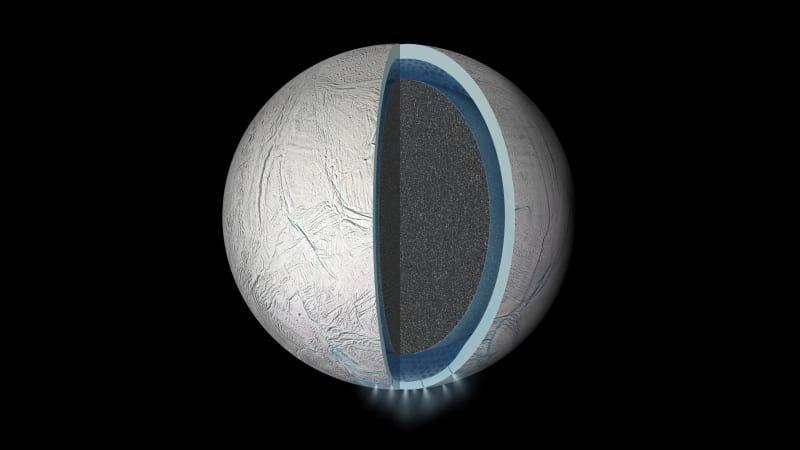
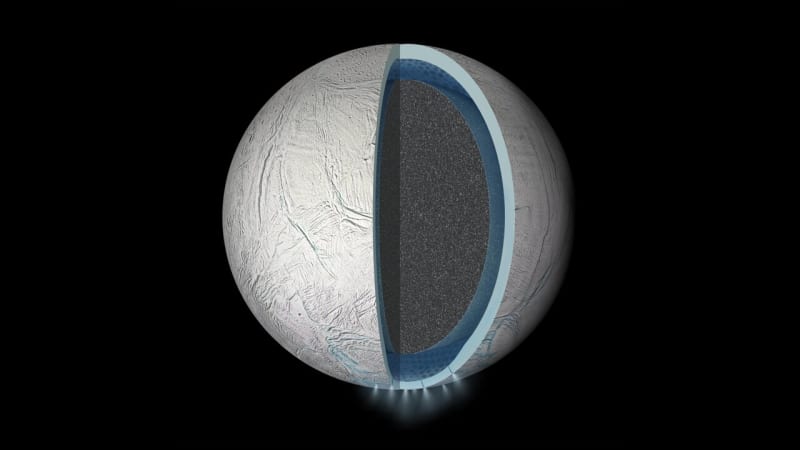
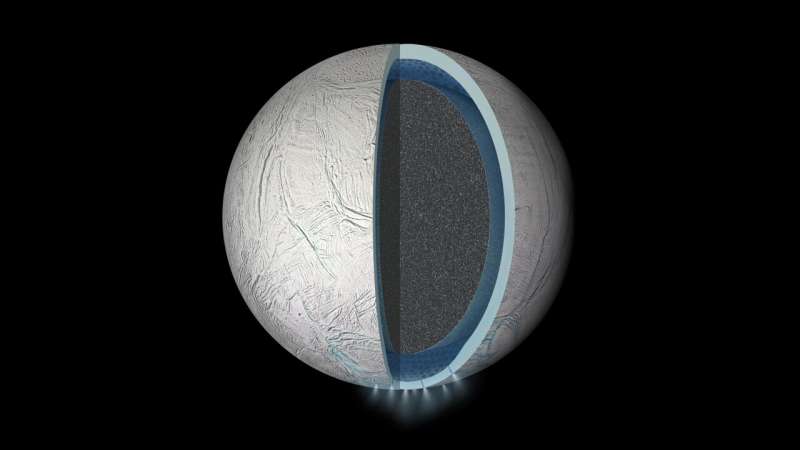
Enceladus, Saturn's sixth largest moon, hides a liquid ocean beneath its thick ice shell. Water-rich plumes regularly shoot through cracks in its frozen surface, creating a trail that feeds one of Saturn's famous rings.
Between 2004 and 2017, NASA's Cassini spacecraft flew through these icy plumes and detected something extraordinary: organic compounds ranging from simple carbon dioxide to complex hydrocarbon chains. On Earth, these same molecules are essential building blocks for life.
But one big question remained unanswered. Were these organic compounds created inside Enceladus, or were they just ancient leftovers from when the moon first formed?
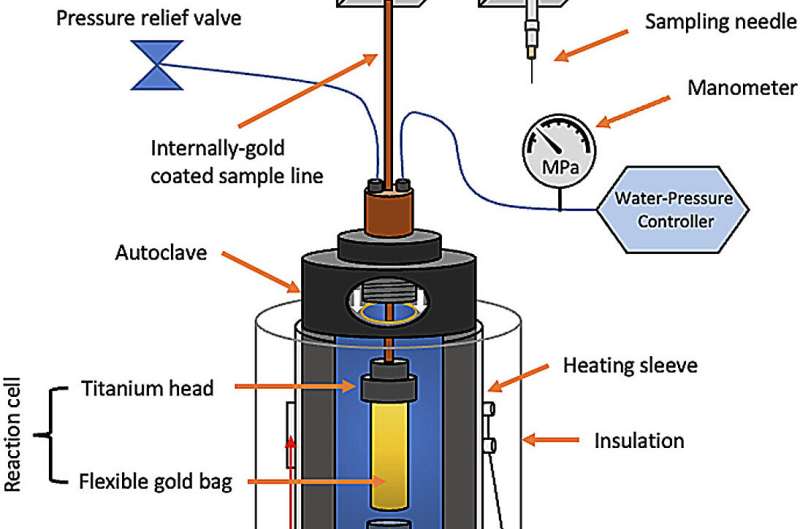
Researchers at the Institute of Science Tokyo decided to find out by recreating Enceladus' ocean right here on Earth. They mixed together the simple compounds Cassini detected, including ammonia and hydrogen cyanide, then subjected the mixture to extreme conditions using a high-pressure reactor.
They heated and froze the mixture repeatedly, mimicking the cycles Enceladus experiences as Saturn's gravity stretches and squeezes the moon. These tidal forces likely trigger hydrothermal activity beneath the ice, allowing smaller molecules to combine into larger, more complex ones.
The team then analyzed their results using a laser-based mass spectrometer designed to work like Cassini's instruments. This allowed them to directly compare their lab-created chemistry with what the spacecraft actually observed.
The Bright Side
The experiments produced an impressive array of complex organic molecules, including amino acids, aldehydes, and nitriles. The freezing process even helped generate simple amino acids like glycine, one of life's fundamental building blocks.
Many of these chemical products matched exactly what Cassini detected in the plumes. The findings show that Enceladus' hidden ocean is likely chemically rich and actively producing the ingredients necessary for life.
Some larger molecules Cassini found didn't appear in the lab experiments. This could hint at even hotter reactions happening deep in Enceladus' ocean, or the presence of ancient organic material from the moon's formation.
Lead researcher Max Craddock says the results will sharpen how future missions interpret plume measurements. Future spacecraft will need instruments capable of verifying amino acids and determining whether complex organics come from ongoing chemical reactions or inherited ancient material.
These observations will be central to evaluating whether Enceladus could actually support life.
More Images
Based on reporting by Google News - Science
This story was written by BrightWire based on verified news reports.
Spread the positivity!
Share this good news with someone who needs it