Scientists See Oxygen Moving Inside Catalysts for First Time
Chinese researchers captured oxygen atoms traveling through the interior of a catalyst, not just on its surface. This breakthrough could revolutionize how we design cleaner, more efficient chemical reactions.
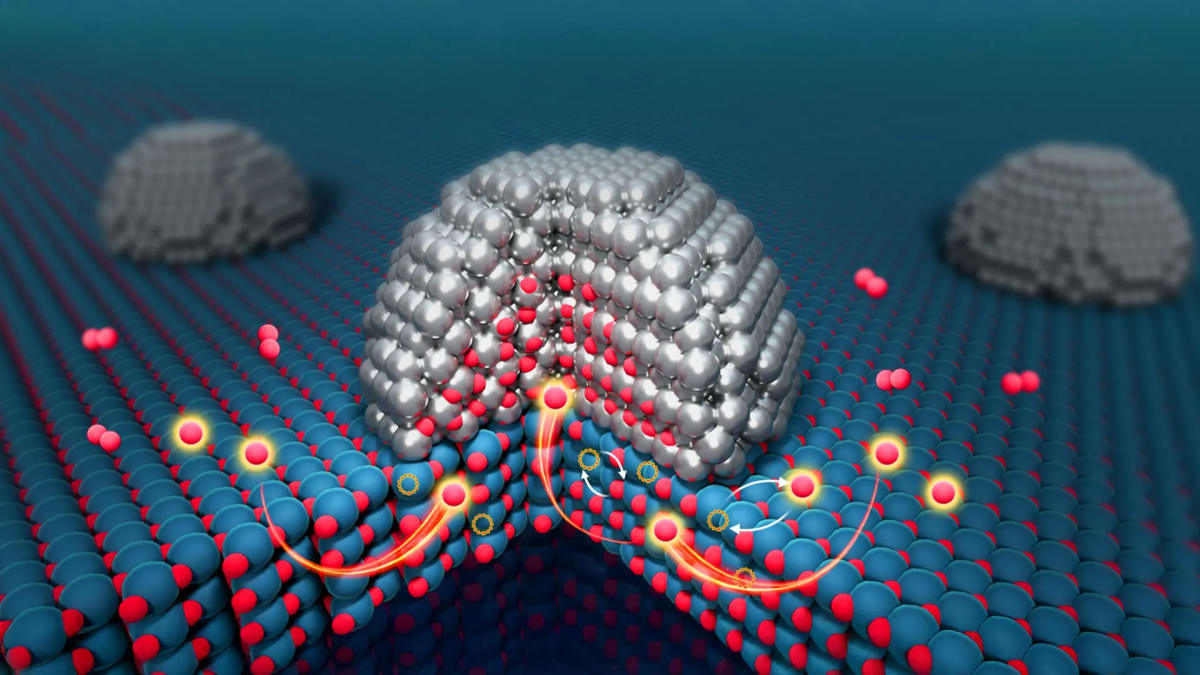
For the first time ever, scientists have watched oxygen atoms journey through the inside of a catalyst, revealing a hidden pathway that could transform how we make everything from clean fuels to medicines.
A team at the Dalian Institute of Chemical Physics in China used powerful microscopy to capture what researchers have wondered about for decades. They saw oxygen moving deep within ruthenium and titanium dioxide catalysts, traveling through layers three to five atoms below the surface.
This matters because catalysts speed up chemical reactions in everything from car exhaust systems to pharmaceutical production. Until now, scientists thought catalysts only worked on their surfaces, like a chef cooking only on the top of a grill.
"A channel has been disclosed to facilitate oxygen spillover, meanwhile the metal-support interface acts like an atomic scale guard, controlling whether oxygen can pass through," said Professor Wei Liu, one of the lead researchers. The discovery, published in Nature this April, shows that the bulk interior of catalysts can actively participate in reactions.
The team chose titanium dioxide because it efficiently stores and releases oxygen. Using environmental transmission electron microscopy, they tracked individual oxygen atoms as they moved from the metal to the support material and back again, driven by differences in chemical potential.
This expands a concept scientists identified nearly 50 years ago called metal-support interaction. Researchers previously believed material exchange happened only at outer surfaces, with the internal boundary playing little role.
Why This Inspires
This breakthrough opens the door to designing catalysts that use their entire structure, not just their surface. Think of it as unlocking 90% of a tool you've only been using 10% of.
Professor Tao Zhang explains the team's vision: "We can improve architecture of catalysis from two-dimensional surface reactions to three-dimensional surface-interface-bulk synergy." Translation? Future catalysts could be far more efficient at cleaning pollution, producing clean energy, and manufacturing chemicals with less waste.
The researchers plan to develop practical catalysts that harness this newly discovered interior pathway. Their work demonstrates how powerful new imaging technology can reveal secrets hidden in plain sight for generations.
A window into the invisible world of atoms is helping scientists build a cleaner, more efficient future.
Based on reporting by Google News - Breakthrough Discovery
This story was written by BrightWire based on verified news reports.
Spread the positivity!
Share this good news with someone who needs it