Scientists Solve 50-Year Black Hole Mystery at Milky Way
After five decades of searching, astronomers have finally detected gentle winds flowing from the supermassive black hole at the center of our galaxy. The discovery reveals how quiet black holes shape galaxies and limits on star formation. #
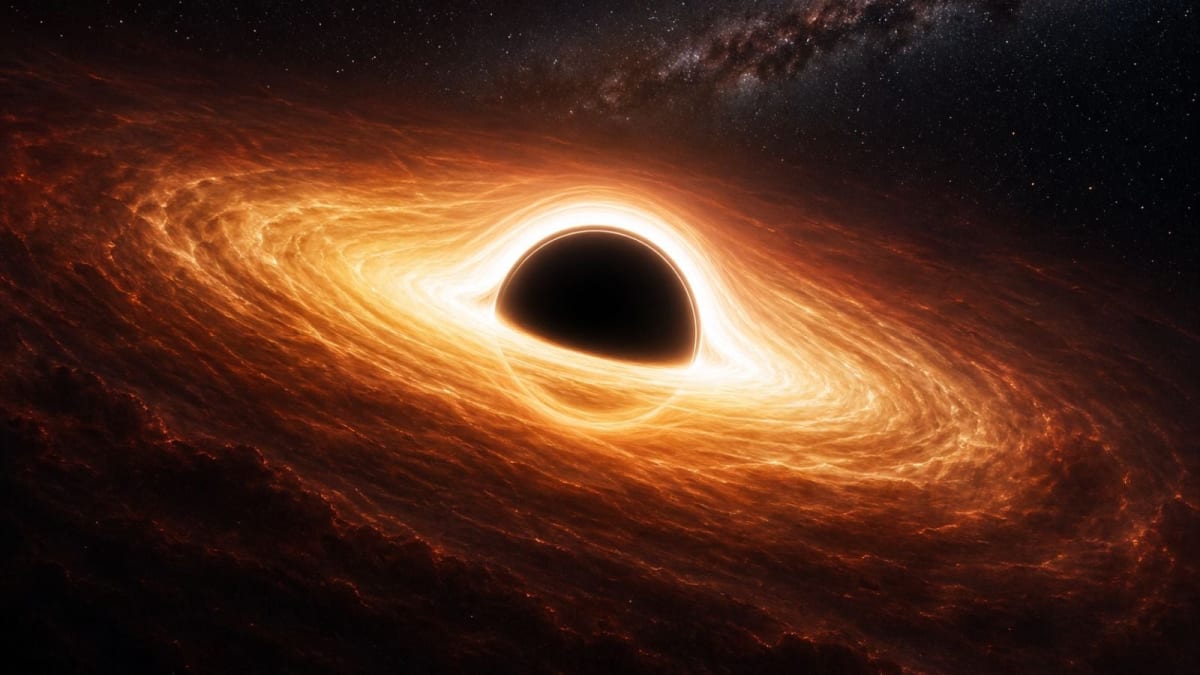
After 50 years of searching, scientists have finally spotted something extraordinary: gentle winds blowing from the massive black hole at the heart of our Milky Way galaxy. The discovery solves a mystery that has puzzled astronomers since the 1970s.
The breakthrough came from 100 hours of careful observation using powerful radio telescopes in Chile. Researchers Lena Murchikova and Mark Gorski from Northwestern University spent five years watching Sagittarius A*, the supermassive black hole sitting at our galaxy's center.
What they found changes everything we thought we knew about black holes. Instead of violent cosmic storms, this black hole produces something more like a gentle breeze, creating a cone-shaped path of hot gas flowing outward into space.
"We've never seen gentle breezes from black holes, but likely that's what they do most of their lives," says Murchikova. "Now, for the first time, we see this gentle breeze from the black hole."
Black holes create winds as they consume gas and dust, heating material that gets pushed away. When black holes feast heavily, these winds become powerful enough to clear entire galaxies of star-forming material.
But Sagittarius A* is different. It sits in a quiet state, producing lighter winds that still sculpt the galaxy around it.
The team's equipment captured images 80 times sharper than previous attempts. They spotted cold carbon monoxide gas near the black hole and noticed a cone-shaped region where this gas had been swept away by hot winds.
Why This Inspires
This discovery shows how even quiet cosmic giants shape the universe around them. The winds slow down star formation and limit how much the black hole itself can grow, creating a natural balance in our galaxy.
The finding proves our galaxy's black hole isn't special or unique. It behaves just like supermassive black holes in other galaxies, producing the same gentle winds that help shape cosmic evolution.
"It would demonstrate that our supermassive black hole is not unique, that it produces a wind just like those in other galaxies," says astrophysicist Rebecca Diesing of Columbia University.
The research opens new doors for understanding how galaxies grow and change over billions of years. With advancing technology, scientists can now study how these cosmic breezes wobble and shift at the edges of the void they create.
After half a century of searching through obscuring gas, dust, and countless stars, astronomers finally have proof that our galaxy's heart beats with the same rhythm as others across the universe.
#
Based on reporting by Indian Express
This story was written by BrightWire based on verified news reports.
Spread the positivity!
Share this good news with someone who needs it