Scientists Solve Saturn's 20-Year Spin Mystery With New Data
For decades, Saturn appeared to be doing the impossible: changing how fast it spins. Scientists using the James Webb Space Telescope just discovered the beautiful truth behind this cosmic illusion.
Saturn wasn't breaking the laws of physics after all. The ringed giant only appeared to be speeding up and slowing down, and scientists finally understand why.
The mystery started in 2004 when NASA's Cassini spacecraft detected something odd. Saturn seemed to be changing its rotation rate over time, which shouldn't be possible for a massive planet.
Professor Tom Stallard from Northumbria University spent years chasing the answer. In 2021, his team proved Saturn's spin wasn't actually changing. Instead, powerful winds in the planet's upper atmosphere were throwing off the measurements scientists used to track rotation.
But that discovery raised a new question. What was driving those mysterious winds?
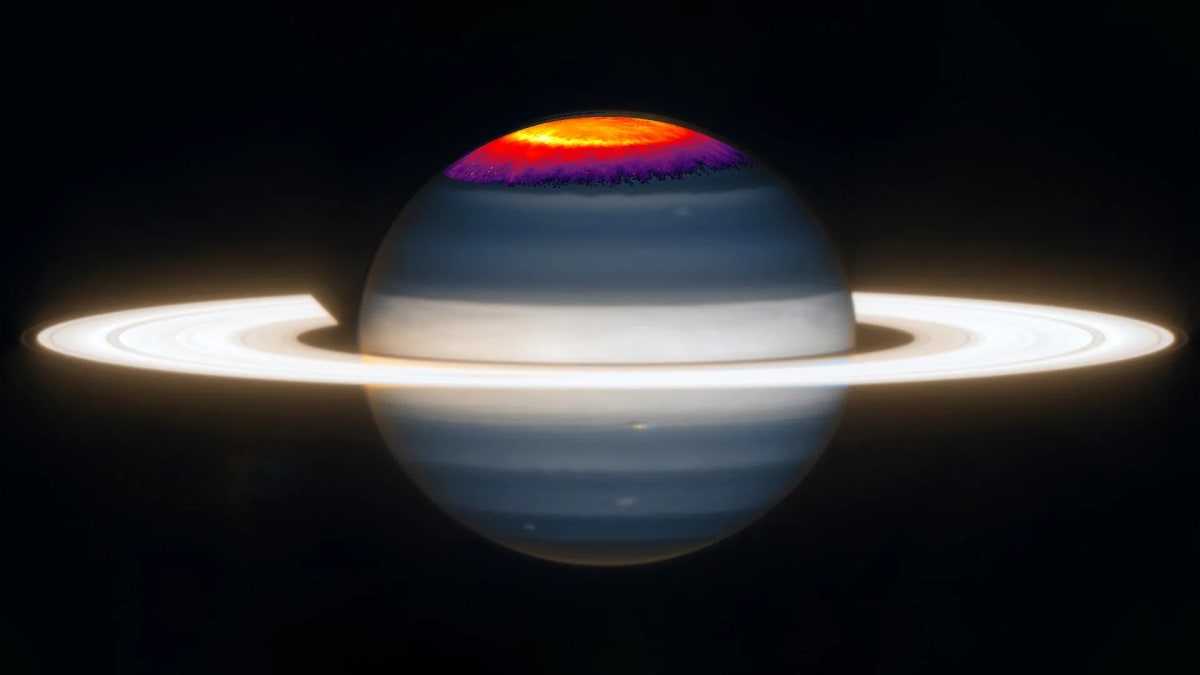
The James Webb Space Telescope provided the breakthrough. Stallard's team observed Saturn's spectacular northern lights continuously for an entire Saturnian day, capturing details no previous instrument could achieve.
They tracked infrared light from a special molecule called trihydrogen cation. This natural thermometer revealed temperature patterns across Saturn's auroral region with stunning precision. The new measurements were ten times more accurate than anything scientists had before.
What they found was remarkable. Saturn's aurora doesn't just create beautiful light shows. It powers an entire planetary heat engine that feeds itself.
Here's how it works. Energy from the aurora heats specific regions of Saturn's atmosphere. That heating generates powerful winds. Those winds create electrical currents that flow through the atmosphere and into space. The currents then power the aurora itself, which keeps heating the atmosphere and sustaining the whole cycle.
"What we are seeing is essentially a planetary heat pump," Stallard said. "The system feeds itself."
This self-sustaining loop finally explained the misleading rotation measurements. The atmospheric winds alter electrical signals from the aurora, making Saturn appear to spin at different speeds depending on how scientists measure it.
The discovery solved a puzzle that had stumped researchers for more than 20 years. But it also revealed something bigger.
Why This Inspires
Saturn's atmosphere and magnetosphere are constantly talking to each other. Activity in the atmosphere influences the vast magnetic field surrounding the planet. The magnetosphere feeds energy back to the atmosphere. This ongoing conversation keeps the whole system stable.
Stallard believes similar processes might happen on other worlds too. "If a planet's atmospheric conditions can drive currents out into the surrounding space environment, then understanding what is happening in the stratospheres of other worlds may reveal interactions we have not yet even imagined," he said.
What started as one planet's puzzling behavior might unlock secrets about how planetary atmospheres work throughout the universe. Sometimes the most beautiful discoveries come from solving mysteries that seemed impossible to crack.
Based on reporting by Science Daily
This story was written by BrightWire based on verified news reports.
Spread the positivity!
Share this good news with someone who needs it