Soviet Probe Survived 4X Longer Than Planned on Venus in 1982
A Soviet spacecraft designed to last 32 minutes on Venus kept working for 127 minutes in heat hot enough to melt lead, sending back the first color photos from another planet's surface. The 1982 mission showed what's possible when engineers push the boundaries of extreme-environment exploration.
On March 1, 1982, a Soviet lander touched down on the most hostile planet in our solar system and refused to quit, surviving nearly four times longer than engineers expected.
Venera 13 was built to last just 32 minutes on Venus's scorching surface. The titanium spacecraft kept transmitting for 127 minutes while sitting in 465°C heat and pressure 89 times greater than Earth's atmosphere at sea level.
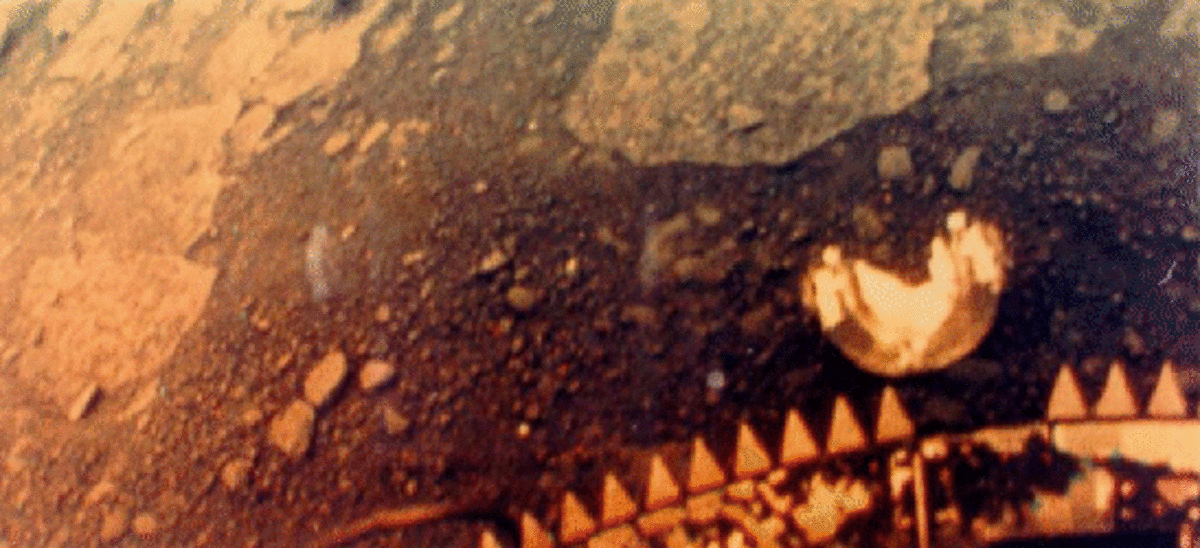
Those extra 95 minutes weren't just a victory lap. The lander drilled into Venusian soil, analyzed its chemical composition, and sent back the first color photographs ever taken from the surface of another planet.
Soviet engineers knew they were designing for failure. Venus combines two nightmare conditions: crushing atmospheric pressure and temperatures that melt lead. No refrigeration system can cool equipment when the outside air is already hundreds of degrees hotter than your instruments.
The solution was elegant and temporary. Engineers built a pressure vessel cooled before launch, wrapped it in insulation, and gave it enough thermal mass to buy time. The 32-minute target wasn't a countdown timer but a conservative estimate of how long the electronics could survive before the heat won.
The journey to those 127 minutes began four months earlier. Venera 13 launched on October 30, 1981, separated from its carrier spacecraft on February 27, 1982, and plunged into Venus's thick atmosphere two days later.
A heat shield absorbed the violent first deceleration. A parachute slowed the descent through the upper atmosphere, giving instruments time to sample the clouds. Then the parachute detached, because Venus's lower atmosphere is so dense the lander's wide platform could glide down on air thick as water.
The spacecraft hit the ground at 7.5 meters per second in a region called Phoebe Regio. Overhead, the carrier spacecraft caught its signal and relayed everything back to Earth.
What Venera 13 saw became iconic. Two cameras scanned the landscape line by line through color filters, transmitting each strip upward. The resulting panoramas showed angular slabs, rocky fragments, and loose material beneath an orange-brown sky.
Earlier Soviet missions had sent back black-and-white images. Venera 11 and 12 carried color cameras, but their lens covers never opened. Venera 13 succeeded where others failed.
The Bright Side
The record still stands. Even the toughest Venera and Vega landers survived between 23 and 127 minutes on Venus, which is why NASA engineers study high-temperature electronics and mechanical rovers for future missions.
That March day in 1982 proved that ambitious engineering can squeeze extraordinary results from impossible conditions. Venera 13 didn't just survive longer than planned; it showed us another world in color for the first time and pushed the boundaries of what we thought machines could endure.
More Images


Based on reporting by Google News - Science
This story was written by BrightWire based on verified news reports.
Spread the positivity!
Share this good news with someone who needs it