Star Goes Dark for 9 Months, Reveals Planet Collision
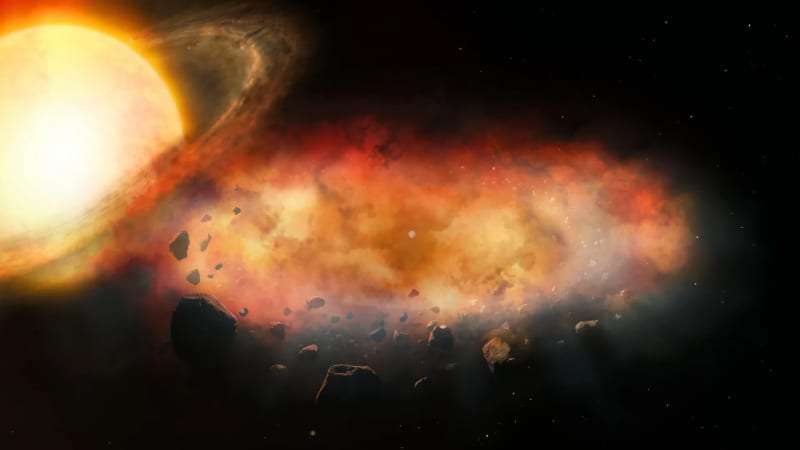
A sun-like star 3,000 light-years away mysteriously dimmed for nine months, revealing a massive cloud of vaporized metals from what scientists believe was a catastrophic planetary collision. For the first time ever, astronomers measured metallic winds swirling inside the cloud, proving that even ancient star systems can still experience dramatic cosmic smashups.
A star just like our Sun suddenly went dark for almost nine months, and what astronomers discovered hiding it is changing how we understand planetary systems.
In September 2024, a star called J0705+0612 located 3,000 light-years from Earth dropped to just one-fortieth of its normal brightness. The dimming lasted until May 2025, baffling scientists who knew that sun-like stars don't just stop shining.
"Stars like the Sun don't just stop shining for no reason," says Nadia Zakamska, a professor at Johns Hopkins University. "So dramatic dimming events like this are very rare."
Realizing they were witnessing something special, Zakamska and her team launched an urgent observation campaign using telescopes in Chile. What they found was stunning: an enormous cloud of gas and dust, spanning 120 million miles across, had drifted in front of the star.
But this wasn't just any cloud. Using a powerful new instrument called GHOST at the Gemini South telescope, scientists peered through the darkness and detected something never seen before: powerful winds of vaporized metals, including iron and calcium, swirling through the cloud.
The team tracked how these metallic gases moved in three dimensions, marking the first time anyone has measured internal gas motions in a disk surrounding a secondary object like a planet or small star. The cloud appears bound to a massive companion object orbiting the distant star, something at least several times bigger than Jupiter.
The most exciting part? The metals and debris likely came from a catastrophic collision between planets. Think two worlds smashing together with such force that rock and metal vaporized into gas.
Why This Inspires
This discovery reminds us that the universe is still full of dramatic action, even in ancient star systems billions of years old. The cosmos isn't static or finished; it's constantly evolving, colliding, and creating.
The breakthrough also showcases what happens when scientists react quickly to unexpected events. Within hours of noticing the dimming, astronomers coordinated observations across multiple telescopes, turning a mysterious cosmic event into groundbreaking science.
"The sensitivity of GHOST allowed us to not only detect the gas in this cloud, but to actually measure how it is moving," Zakamska explains. "That's something we've never been able to do before in a system like this."
The finding offers hope for understanding how planetary systems continue to change over time. Our own solar system likely experienced similar violent events billions of years ago, possibly creating Earth's moon when a Mars-sized object crashed into our young planet.
Now, for the first time, we're watching that same kind of cosmic drama unfold in real-time light-years away, proving the universe still has spectacular surprises waiting to be discovered.
Based on reporting by Science Daily
This story was written by BrightWire based on verified news reports.
Spread the positivity!
Share this good news with someone who needs it