Swedish Lab Turns Quantum Computer Noise Into Cooling Power
Scientists at Chalmers University just solved one of quantum computing's biggest paradoxes by building a refrigerator that uses noise as fuel instead of fighting it. This breakthrough could help make powerful quantum computers practical for everyday use.
Quantum computers promise to revolutionize everything from medicine to artificial intelligence, but they have a frustrating problem. The same cooling systems that keep them working also create noise that destroys the fragile quantum information they're trying to protect.
Researchers at Chalmers University of Technology in Sweden just flipped that problem upside down. They built a tiny quantum refrigerator that actually uses noise to drive cooling instead of battling against it.
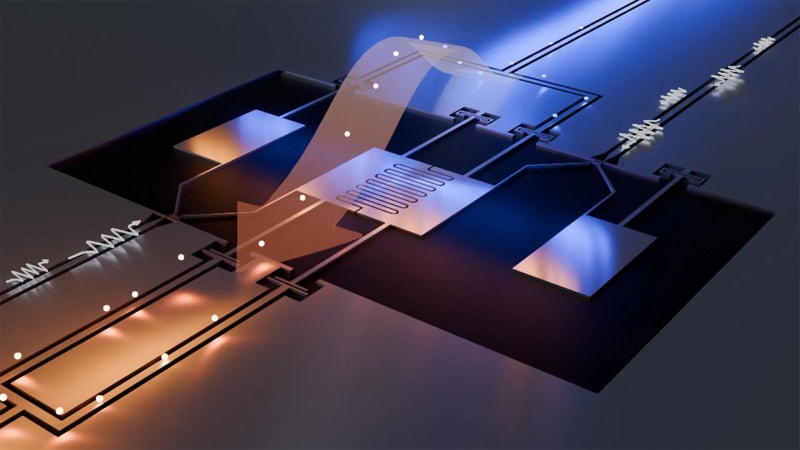
The device sits at the heart of a superconducting artificial molecule built in the lab's nanofabrication facility. Unlike natural molecules made of atoms, this one is constructed from tiny superconducting electrical circuits that must operate near absolute zero, around negative 273 degrees Celsius.
Here's where it gets clever. The team connects the artificial molecule to multiple microwave channels that act as hot and cold reservoirs. By adding carefully controlled microwave noise through a third port, they can steer heat and energy through the system with remarkable precision.
"Physicists have long speculated about a phenomenon called Brownian refrigeration, the idea that random thermal fluctuations could be harnessed to produce a cooling effect," says Simone Gasparinetti, associate professor at Chalmers and senior author of the study published in Nature Communications. "Our work represents the closest realization of this concept to date."
The heat flows they measured are almost impossibly small. We're talking attowatts, or 10 to the negative 18th watts. If you tried to heat a single drop of water with that amount of energy, it would take the entire age of the universe to raise the temperature by one degree Celsius.
The Bright Side
This breakthrough matters because quantum computers face a serious scaling problem. As researchers try to build bigger systems to solve real world problems, heat and noise become harder to control. Larger quantum computers create more opportunities for unwanted energy to spread and destroy delicate quantum states.
The new refrigerator can operate in multiple modes depending on the conditions. Sometimes it acts as a refrigerator, sometimes as a heat engine, and sometimes as an energy amplifier. This flexibility is crucial for managing heat that builds up locally during qubit operation and measurement.
"We see this as an important step toward controlling heat directly inside quantum circuits, at a scale that conventional cooling systems can't reach," says researcher Aamir Ali. "Being able to remove or redirect heat at this tiny scale opens the door to more reliable and robust quantum technologies."
The team believes their approach offers a practical path forward for quantum computers that need to solve problems in drug discovery, secure communications, and logistics optimization. Instead of viewing noise as the enemy, they've turned it into a tool that makes quantum systems more stable and controllable.
This tiny refrigerator might just help quantum computers finally deliver on their world changing promise.
Based on reporting by Science Daily
This story was written by BrightWire based on verified news reports.
Spread the positivity!
Share this good news with someone who needs it