Two Telescopes Team Up to Capture Stunning Black Eye Galaxy
The James Webb Space Telescope and Hubble just revealed the most detailed image ever of a galaxy with a dark ring around its glowing core. Their partnership shows how working together beats going solo, even in space.
A galaxy 17 million light years away looks like it's staring right back at us, and two of humanity's most powerful telescopes just captured its best portrait yet.
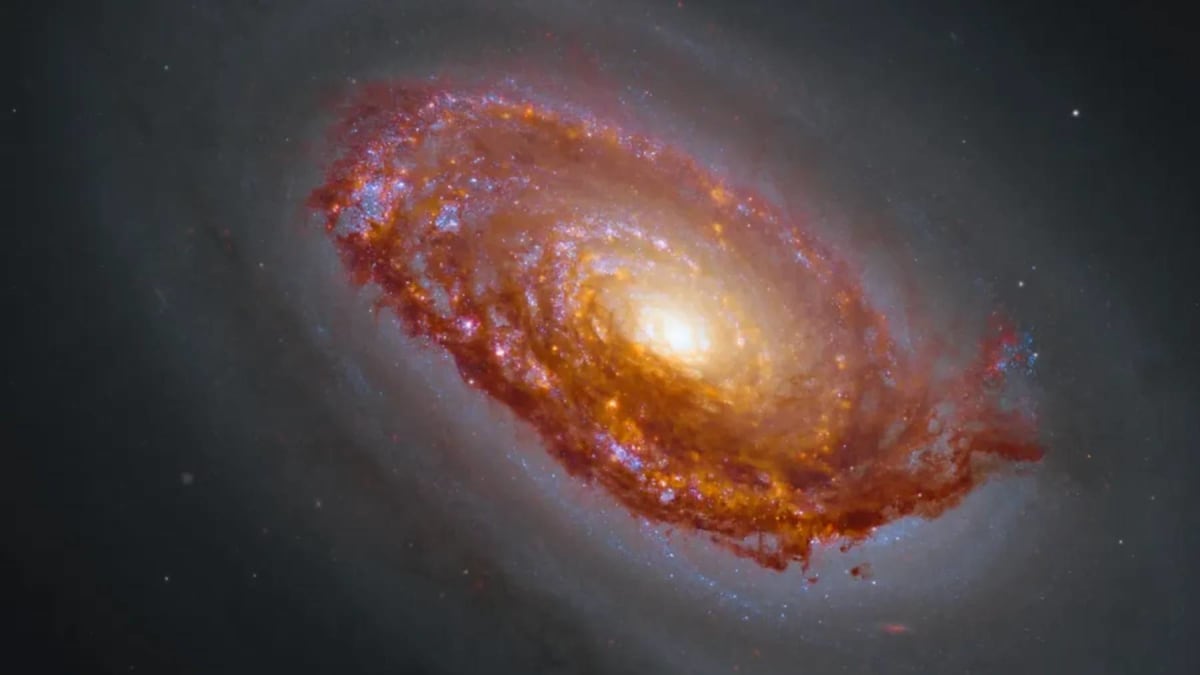
Messier 64, nicknamed the Black Eye Galaxy for the dark dust ring circling its bright center, has fascinated astronomers since its discovery in 1779. Now the James Webb Space Telescope and Hubble have teamed up to create a composite image that reveals details neither could capture alone.
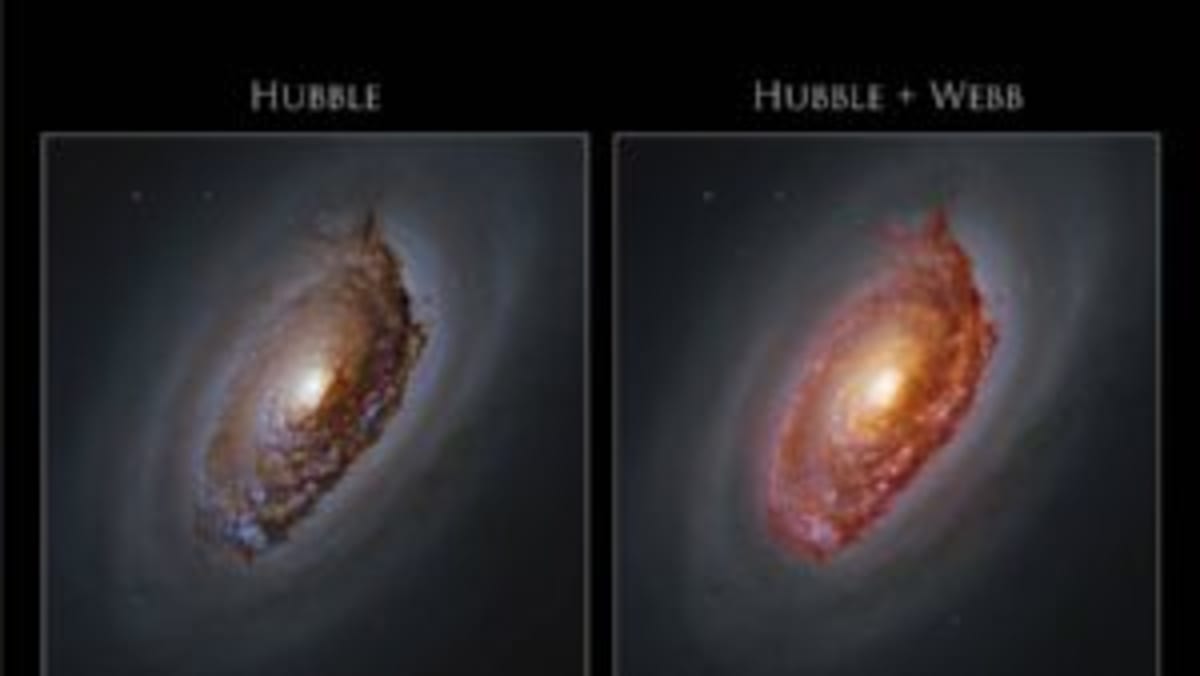
The new picture combines Webb's infrared vision, which sees through dust to reveal cooler stars and hidden structures, with Hubble's ability to capture ultraviolet and visible light that shows where new stars are forming. Together, they paint a complete picture of a galaxy doing something genuinely weird.
Inside the Black Eye Galaxy, two regions spin in opposite directions. The outer gas rotates one way while the inner stars and gas turn the other, like two parts of a cosmic machine fighting each other. Most spiral galaxies spin consistently throughout, making this galactic tug of war a natural laboratory for studying how galaxies evolve and merge over billions of years.
What makes Messier 64 especially useful for research is its isolation. Unlike many spiral galaxies crowded by neighbors, this one sits relatively alone in the constellation Coma Berenices, making it easier to study without interference from other systems.
The partnership between Webb and Hubble wasn't about competition. Each telescope did what it does best, then scientists layered the results into something more powerful than either observation alone. This approach is shaping the future of astronomy as next generation tools like NASA's upcoming Nancy Grace Roman Space Telescope prepare to join the collaboration.
Why This Inspires
There's something hopeful about watching our most advanced instruments work together instead of replacing each other. The same teamwork principle that makes collaborative science stronger applies everywhere, from classrooms to boardrooms to communities solving problems together.
Even more inspiring: despite being at the frontier of cutting edge research, the Black Eye Galaxy is still visible through small backyard telescopes. Amateur astronomers anywhere can point a modest instrument toward the sky and find the same object professionals study with billion dollar observatories.
A galaxy discovered before the United States existed as a country is still revealing new secrets in 2026, reminding us that some questions reward patience and some mysteries unfold across centuries.
More Images

Based on reporting by Google: James Webb telescope
This story was written by BrightWire based on verified news reports.
Spread the positivity!
Share this good news with someone who needs it