Webb Telescope Captures 8-Million-Sun Black Hole's Glow
The James Webb Space Telescope has captured stunning images of a supermassive black hole 45 million light-years away that shines brighter than its entire home galaxy. The telescope's powerful instruments are revealing secrets of star formation and galactic evolution in unprecedented detail.
A cosmic powerhouse 45 million light-years away is giving scientists their clearest view yet of how black holes shape galaxies and spark new stars.
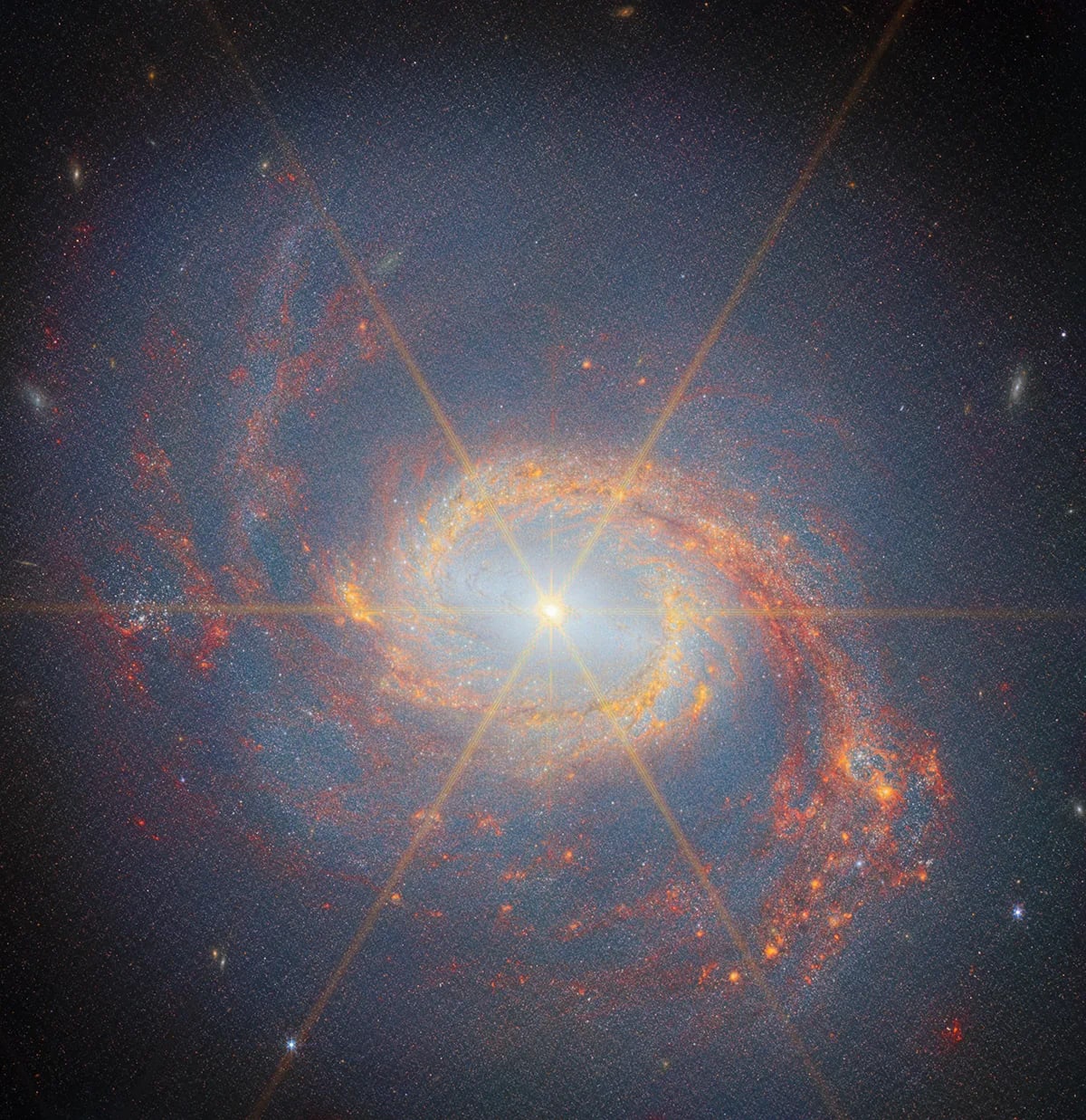
The James Webb Space Telescope has captured breathtaking images of Messier 77, a spiral galaxy in the constellation Cetus. At its heart sits a supermassive black hole eight million times the mass of our Sun, glowing so intensely it outshines the galaxy's billions of stars.
The black hole creates this spectacular light show through pure physics. As gas and dust spiral toward the black hole at tremendous speeds, friction heats the material to extreme temperatures, releasing brilliant energy across the galaxy.
Webb's advanced instruments revealed something even more exciting beyond the blazing core. The telescope spotted a ring spanning more than 6,000 light-years packed with newborn stars, appearing as dense orange bubbles in the images.
These star nurseries are cranking out new suns at extraordinary rates. The discovery helps scientists understand how black holes and star formation work together, rather than against each other as once thought.
The Ripple Effect
This observation is part of Webb's broader mission to survey massive nearby galaxies in unprecedented detail. The telescope's sharp vision allows astronomers to see individual star clusters and gas clouds that were invisible to previous instruments.
Scientists nicknamed M77 the Squid Galaxy because of its tentacle-like outer arms of hydrogen gas. Webb's images show these filaments in stunning clarity, revealing the swirling patterns of cosmic dust that feed ongoing star formation.
The data from these observations will help researchers trace the complete lifecycle of stars from birth to death across the universe. Each new Webb image provides pieces to solve longstanding puzzles about how galaxies evolve and how star formation spreads through space.
What makes this particularly powerful is accessibility. Webb is democratizing space discovery, giving astronomers worldwide the tools to explore distant galaxies with clarity once thought impossible.
The telescope continues surveying nearby massive galaxies, promising more revelations about the cosmic forces that shape our universe and everything in it.
More Images

Based on reporting by Google: James Webb telescope
This story was written by BrightWire based on verified news reports.
Spread the positivity!
Share this good news with someone who needs it