Webb Telescope Finds Alien Comet Unlike Any in Our System
The James Webb Space Telescope just captured the first detailed chemical fingerprint of a visitor from another star system, and it's surprisingly different from comets born near our Sun. The interstellar wanderer is rewriting what we know about how planets form in distant solar systems.
Scientists just got their first close look at a comet from another star system, and it's nothing like the icy travelers we're used to seeing.
In December, the James Webb Space Telescope pointed its powerful infrared instruments at Comet 3I/ATLAS twice as it journeyed away from our Sun. The telescope captured something never seen before: methane gas hidden beneath the surface of an interstellar visitor.
The comet was about 330 million kilometers from the Sun during the first observation on December 15-16. By the second observation on December 27, it had traveled to roughly 380 million kilometers away.
Webb's instruments revealed that this cosmic traveler is surprisingly rich in carbon dioxide and has an unusually high methane-to-water ratio. Most comets formed in our solar system don't show these characteristics at all.
The methane discovery was particularly exciting because it appears to have been buried deep below the surface, protected from evaporating until the Sun's heat warmed the comet's deeper icy layers. This detective work gives scientists clues about where and how the comet originally formed in its home star system.
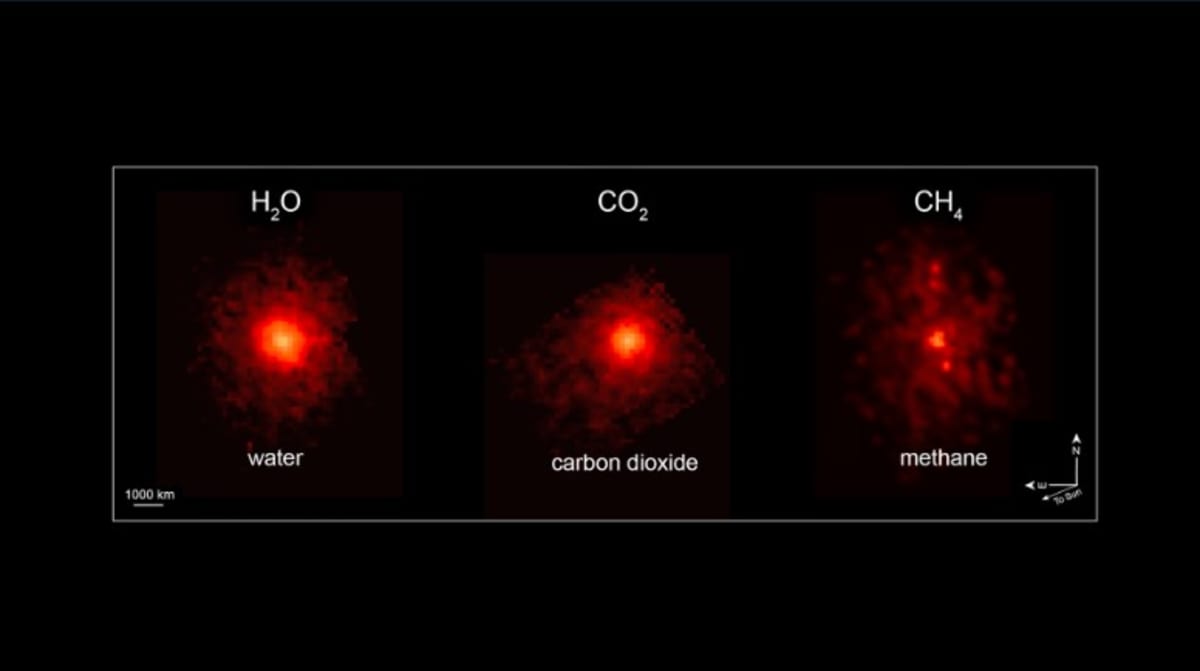
Webb's infrared maps showed how different gases spread around the comet's nucleus. Water vapor drifted widely because icy grains in the surrounding cloud released it gradually. Carbon dioxide and methane, however, stayed concentrated much closer to the comet's core.
The team used Webb's Medium Resolution Spectrometer to split infrared light into its component wavelengths. This created a detailed map showing exactly where each type of gas was located around the comet.
The Ripple Effect
This discovery does more than satisfy our curiosity about a single comet. Every interstellar visitor carries a message in a bottle about how other solar systems form and evolve.
The unusual chemical makeup of 3I/ATLAS suggests it formed in conditions very different from the neighborhood where Earth and our neighboring planets took shape. Understanding these differences helps scientists piece together how planetary systems across the galaxy can vary wildly from our own.
The findings appeared in The Astrophysical Journal Letters, giving astronomers their most detailed look yet at chemistry from beyond our solar system. Each observation brings us closer to understanding our cosmic neighbors.
As Webb continues watching the skies, more interstellar visitors will pass through, each one teaching us something new about the incredible diversity of worlds beyond our Sun.
Based on reporting by Google: James Webb telescope
This story was written by BrightWire based on verified news reports.
Spread the positivity!
Share this good news with someone who needs it
%2Fhttps%3A%2F%2Ftf-cmsv2-smithsonianmag-media.s3.amazonaws.com%2Ffiler_public%2F58%2F0a%2F580a77b9-7590-43c5-b70d-e3a590810348%2Fsmithmag-rockwell-edit.jpg)