Webb Telescope Finds Black Hole Heavier Than Its Galaxy
Scientists just made the first direct measurement of a supermassive black hole from the early universe, and it rewrites what we thought we knew about how galaxies form. The cosmic giant weighs 50 million times more than our Sun and somehow grew bigger than all the stars around it.
For the first time ever, astronomers have directly weighed a black hole from when the universe was just a baby, and the answer is turning cosmology textbooks upside down.
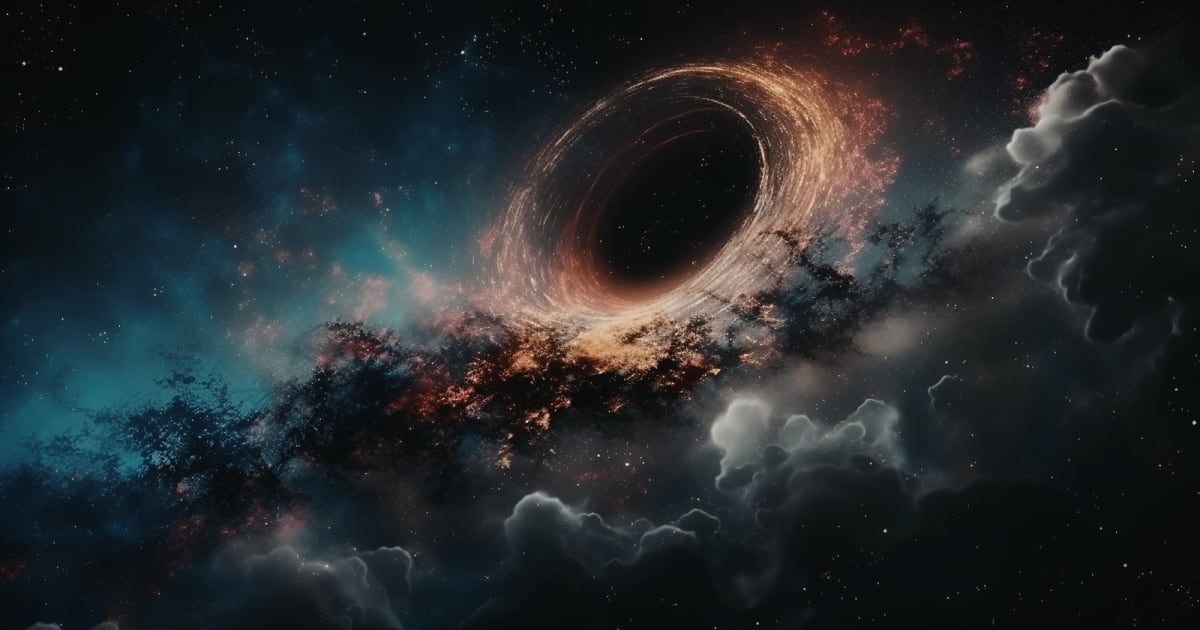
The James Webb Space Telescope captured measurements of a supermassive black hole sitting in a tiny galaxy called Abell2744-QSO1, seen as it looked just 700 million years after the Big Bang. The black hole tips the scales at 50 million times the mass of our Sun.
Here's what shocked scientists: this black hole outweighs every single star in its galaxy combined. It accounts for two-thirds of the entire system's mass, making it at least twice as heavy as all the stars put together.
That ratio breaks everything we thought we knew about galaxy formation. In our local universe, supermassive black holes make up only about 0.1% of their galaxy's stellar mass. This ancient black hole is thousands of times more dominant than it should be.
Graduate student Ignas Juodžbalis and researcher Cosimo Marconcini led the measurement by mapping the speed of gas swirling around the black hole. They watched for a signature pattern called Keplerian motion, the same principle that lets us weigh our Sun by watching how fast planets orbit.
Previous estimates of early black holes relied on assumptions that conditions in the ancient universe matched what we see today. Francesco D'Eugenio explained the problem simply: "We didn't know if those assumptions really apply to the distant universe."
The gas moved in perfect Keplerian orbits, proving the mass was concentrated in one point rather than spread among stars. "This tells us that most of the mass is concentrated in the black hole at the center," Juodžbalis said.
The galaxy itself is remarkably small and faint, with fewer than 20 million solar masses worth of stars. The surrounding gas is almost pure hydrogen and helium, chemically pristine from the dawn of time.
Why This Inspires
This discovery opens a window into a cosmic mystery scientists are just beginning to understand. The standard story says galaxies form first, then black holes grow slowly alongside them over billions of years. But QSO1 flips that script entirely.
The black hole belongs to a class of objects called Little Red Dots, compact red sources common in the first billion years after the Big Bang but almost completely absent today. Webb found them shortly after starting operations in 2022, and scientists are still figuring out what they mean.
The finding suggests some black holes in the early universe formed through a completely different process than the gradual growth we see today. There simply wasn't enough time or material for this black hole to have grown the traditional way.
Two papers published simultaneously in Nature and Monthly Notices of the Royal Astronomical Society detail the historic measurement. Roberto Maiolino of Cambridge University, who led the companion study, called it "a phenomenal result."
The discovery reminds us that the universe still holds profound surprises, and our most advanced tools are finally powerful enough to catch them in the act.
More Images


Based on reporting by Google: James Webb telescope
This story was written by BrightWire based on verified news reports.
Spread the positivity!
Share this good news with someone who needs it