Webb Telescope Finds Mature Galaxy 9 Billion Years Ago
The James Webb Space Telescope discovered a fully formed galaxy with an organized star-making center when the universe was just 4.5 billion years old. Scientists thought galaxies needed much more time to develop such sophisticated structures.
Astronomers just spotted a galaxy that grew up way faster than anyone expected, rewriting what we know about how galaxies form.
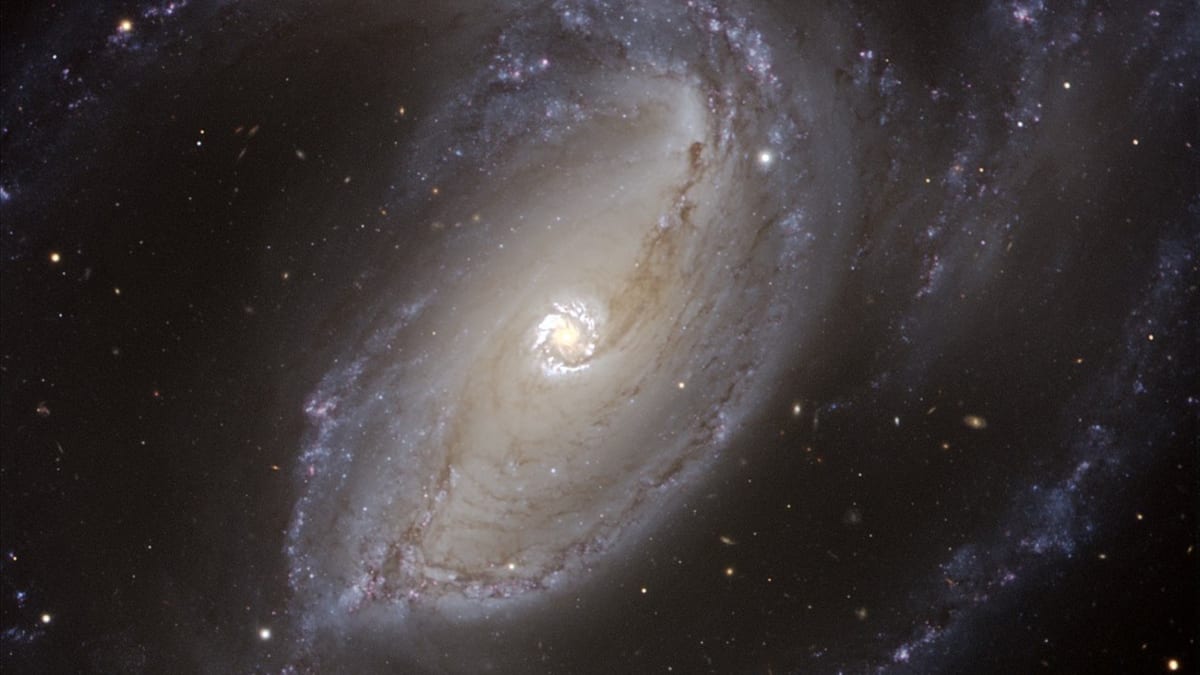
The James Webb Space Telescope found galaxy CEERS-4031 looking surprisingly mature when the universe was only 4.5 billion years old, about a third of its current age. At its heart sits a spinning disc of hot young stars, the most distant structure of its kind ever detected.
This discovery matters because galaxies weren't supposed to organize themselves this early. Scientists thought the young universe was too wild and chaotic for galaxies to settle into orderly shapes with dense, star-building centers.
Zoe Le Conte, a Ph.D. researcher at Durham University who led the discovery team, explained what makes this finding so significant. "This structure indicates that the galaxy has undergone rapid evolution and reached a later, more mature stage," she told Earth.com.
The galaxy is as massive as our Milky Way, with a nuclear disc just a few thousand light-years across at its center. This disc glows blue with newly formed stars, spinning fast and building new suns at a remarkable pace.
What drove this rapid growth was a stellar bar, a long lane of stars about 17,000 light-years long that acts like a cosmic conveyor belt. As the galaxy rotates, the bar drags gas inward toward the center where it pools, cools, and ignites into bursts of star formation.
This bar-driven construction usually takes billions of years in nearby galaxies. Finding it happening so quickly in the early universe surprised the research team.
Inside the nuclear disc, the scientists found even more intricate details. A second smaller bar and spiral arms twist through the center, likely funneling gas even deeper toward the galaxy's supermassive black hole.
Why This Inspires
This discovery shows the universe was far more capable than we imagined in its youth. Galaxies weren't just chaotic clouds of gas stumbling through space. They were already building the organized, star-filled structures we see around us today.
The James Webb Space Telescope keeps revealing that cosmic evolution happened faster and more elegantly than our models predicted. Each discovery pushes back the timeline for when order emerged from chaos.
What's particularly exciting is that this disc is large enough to spot from nine billion light-years away. Smaller discs at such distances remain invisible even to Webb's powerful instruments, but bigger telescopes now under construction should find them soon.
Le Conte and her team plan to continue mapping how bars form in distant galaxies and how they shape galaxy evolution. Each discovery fills in another piece of the puzzle showing how galaxies like our own came together.
The finding reminds us that the universe has always been more dynamic and organized than we give it credit for, building beautiful structures even in its wildest youth.
Based on reporting by Google: James Webb telescope
This story was written by BrightWire based on verified news reports.
Spread the positivity!
Share this good news with someone who needs it