Webb Telescope Maps Weather on Planet With Liquid Rock Rain
For the first time, scientists tracked how weather changes across an alien world during a single transit, revealing a scorching gas giant with a 3,000-degree evening side and a possibly cloudy morning. The breakthrough technique opens a new way to understand distant planets as dynamic worlds with their own weather patterns.
Scientists have mapped weather patterns across an alien world in real time, watching as a distant gas giant rotated during its journey across its star.
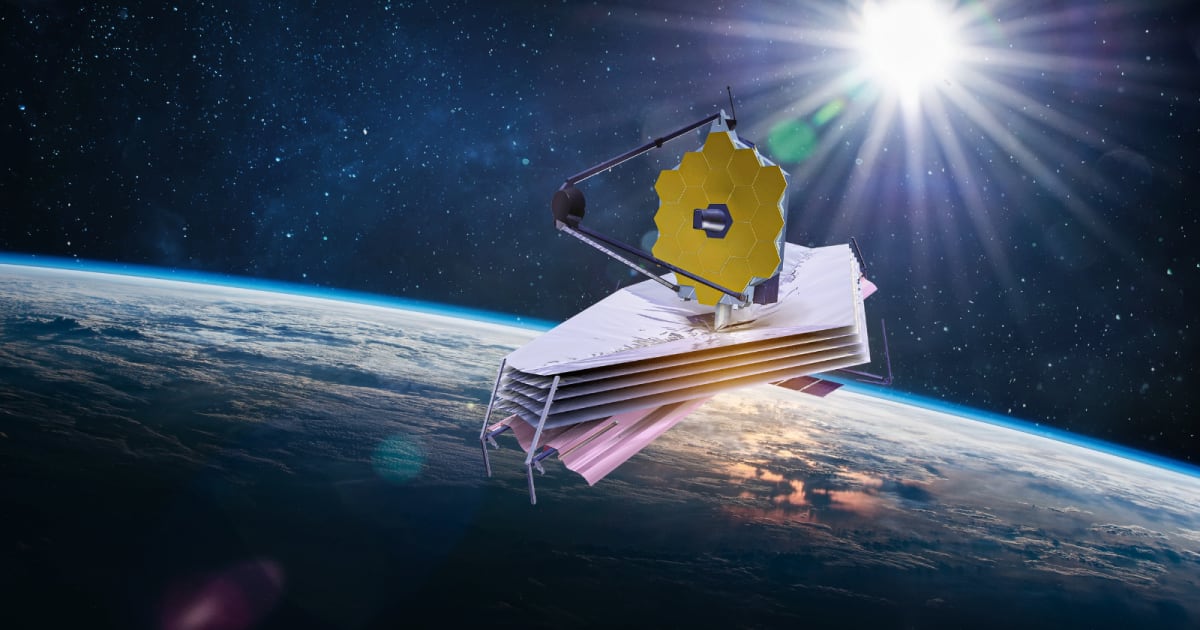
The James Webb Space Telescope captured how the atmosphere of WASP-121b changes from morning to evening on a planet so hot that rocks can vaporize into clouds. Led by Cyril Gapp of the Max Planck Institute for Astronomy, the team published their findings in Nature Astronomy in June 2026.
The planet rotated about thirty degrees as it crossed in front of its star, letting Webb measure different atmospheric regions during a single transit. The evening side appeared hotter and more expanded, reaching temperatures near 2,770 Kelvin (about 4,500 degrees Fahrenheit). The morning side stayed cooler at around 1,000 Kelvin and may contain clouds formed from condensed rock vapor, though scientists need more observations to confirm.
Gapp explained the method simply: "By measuring how starlight absorption changes as WASP-121b rotates, we probe its atmosphere longitude by longitude." The atmosphere blocked more starlight later in the transit, revealing that heat shifts eastward from the point directly beneath the star.
WASP-121b circles its star every 1.3 days and stays tidally locked, meaning one face always points toward the star while the other faces away. At these extreme temperatures, water molecules break apart on the evening side, while rocky and metallic compounds can vaporize and potentially recondense elsewhere in the atmosphere.
Why This Inspires
This discovery proves that distant planets aren't featureless spheres but complex worlds with their own weather systems, temperature zones, and atmospheric dynamics. Previous observations averaged the morning and evening sides together, creating a blurred picture that didn't represent either side accurately.
Now astronomers can distinguish between a planet's morning and evening regions, revealing weather patterns that help explain how these worlds formed and evolved. The technique works because these planets rotate fast enough to show different faces during a single pass across their star.
Tom Evans-Soma of the University of Newcastle called WASP-121b "particularly extreme," but that extremity makes it an ideal laboratory for testing new observation methods. What scientists learn from these ultra-hot worlds helps them understand the full range of planetary atmospheres throughout the galaxy.
The discovery changes how astronomers will study exoplanets moving forward. Instead of treating distant worlds as single atmospheric columns, they can now build weather maps showing how temperature, chemistry, and cloud cover vary across a planet's surface.
Every new technique for studying distant worlds brings us closer to understanding the incredible diversity of planets beyond our solar system.
More Images



Based on reporting by Google: James Webb telescope
This story was written by BrightWire based on verified news reports.
Spread the positivity!
Share this good news with someone who needs it