Webb Telescope Reveals 150 Star Nurseries Behind Orion
The James Webb Space Telescope just captured something incredible hiding behind the famous Orion Nebula: a massive stellar nursery where hundreds of new stars are being born right now. Scientists can now see every stage of star formation happening in real time, 1,280 light-years from Earth.
The James Webb Space Telescope just gave us front-row seats to one of the universe's most beautiful shows: the birth of stars.
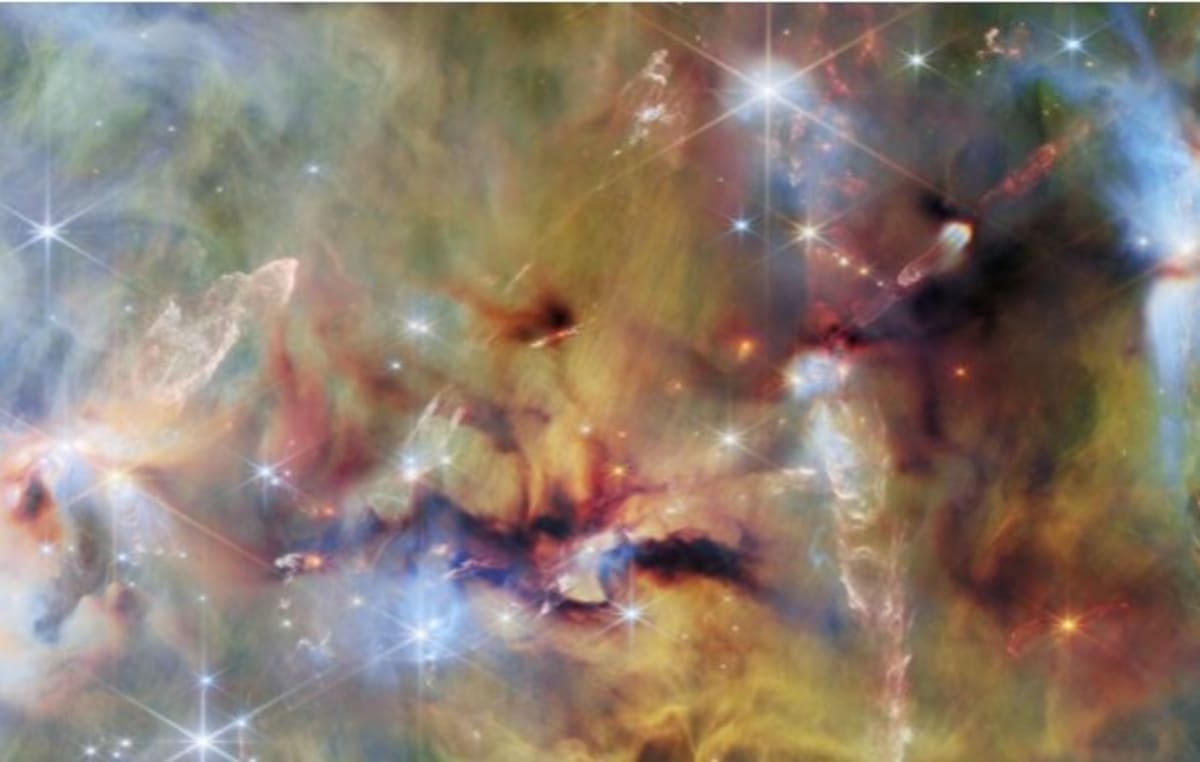
Behind the glowing gas and bright stars of the famous Orion Nebula lies a hidden treasure called OMC-2, a vast cloud of gas and dust spanning 150 light-years. Webb's powerful infrared camera peered through the cosmic curtain to reveal something our eyes could never see: dozens of baby stars in the process of being born.
These protostars are like stellar infants, pulling in material from surrounding clouds through spinning disks of gas and dust. As the gas falls onto these growing stars, it heats up and shoots twin jets from their poles, creating spectacular outflows that blast through space at incredible speeds.
The jets generate shockwaves that heat the surrounding gas, making it glow in brilliant ridges of red, orange, and gold. By following these colorful trails, scientists can track down hidden protostars still wrapped in their cosmic blankets of dust.
OMC-2 sits just 1,280 light-years from Earth, making it one of our closest windows into stellar birth. The region is packed with activity: young stars lighting up their neighborhoods, darker clouds where future stars will form, and everything in between.
Webb's infrared vision is essential here because visible light can't punch through the thick dust surrounding these stellar nurseries. Instead, the telescope captures the warm glow of dust in orange and red, the scattered light from young stars in blue and cyan, and the green-yellow shimmer of complex molecules forming in space.
Why This Inspires
This discovery does more than dazzle us with pretty pictures. Scientists are using Webb's data to answer fundamental questions about how stars like our sun are born, how planets form around them, and how the chemistry of life itself might begin in these cosmic clouds.
Because OMC-2 is relatively close to Earth, it serves as a perfect laboratory for studying the earliest stages of stellar evolution. Researchers will examine how powerful outflows from young stars influence the birth of their neighbors, and how ultraviolet light shapes the disks where planets eventually form.
These stellar nurseries show us that creation is constant in our universe. Right now, at this very moment, new stars are igniting, new planetary systems are taking shape, and the raw materials for future worlds are swirling together in cosmic clouds.
Every stage of star formation is happening simultaneously in OMC-2, giving scientists an unprecedented view of how our own solar system might have looked 4.6 billion years ago. The universe is still young, still growing, still creating new wonders for us to discover.
Based on reporting by Google: James Webb telescope
This story was written by BrightWire based on verified news reports.
Spread the positivity!
Share this good news with someone who needs it