Webb Telescope Solves Black Hole Puzzle After 30 Years
NASA's Webb telescope just rewrote what scientists thought they knew about black holes. The discovery revealed that feeding black holes are far tidier eaters than anyone imagined.
Scientists just got their clearest look yet at how a black hole eats, and the discovery flips three decades of assumptions on their head.
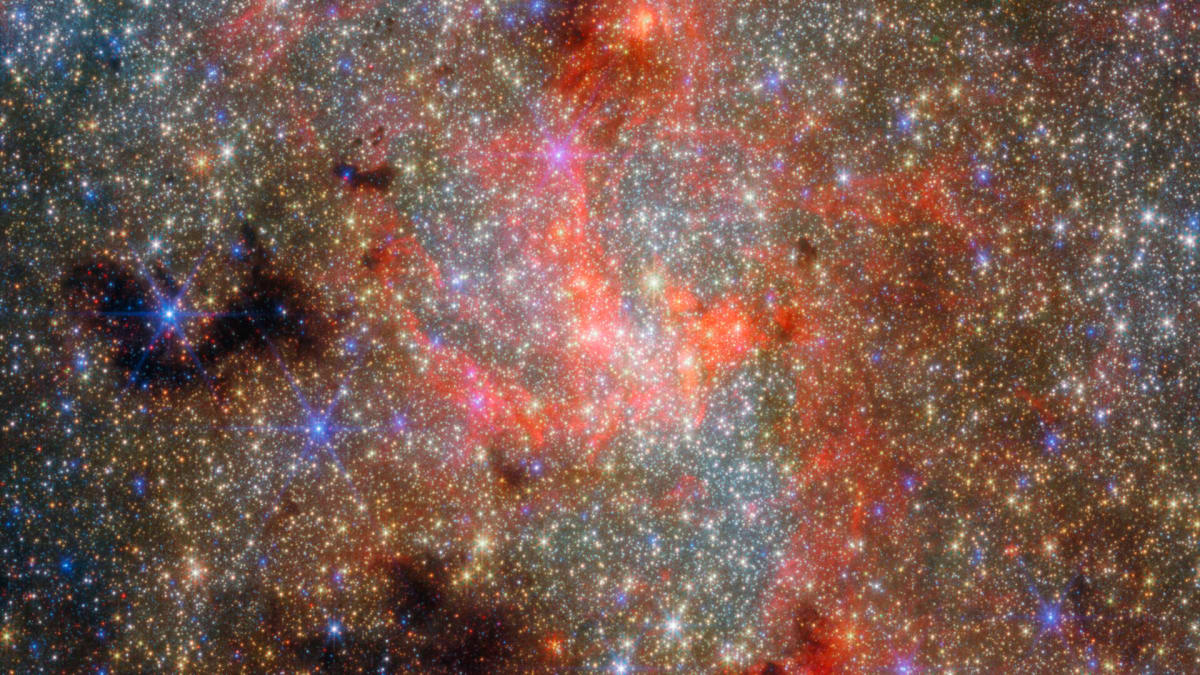
NASA's James Webb Space Telescope peered into the Circinus galaxy, 13 million light-years away, and mapped exactly where dust gathers around its supermassive black hole. What the team found surprised everyone: a whopping 87 percent of the glowing dust sits in a neat, compact ring feeding the black hole, while less than 1 percent escapes as exhaust.
For 30 years, astronomers believed the brightest infrared light around black holes came from massive streams of hot matter blasting outward. The new observations, published in Nature, prove that theory wrong.
"Since the '90s, it has not been possible to explain excess infrared emissions that come from hot dust at the cores of active galaxies," said lead researcher Enrique Lopez-Rodriguez from the University of South Carolina. The models could only account for either the feeding ring or the outflows, never both.
The ring, called a torus, acts like a cosmic traffic controller. It funnels material toward the black hole while shaping how energy escapes into the surrounding galaxy.
Webb's secret weapon was its Aperture Masking Interferometer, which transforms the telescope into a mini array. The tool combines light through seven small openings to create super-sharp images of features previously too tiny to see.
"By using an advanced imaging mode of the camera, we can effectively double its resolution," said co-author Joel Sanchez-Bermudez, an astrophysicist at the National University of Mexico. This marks the first time scientists have used a space infrared interferometer for a target beyond the Milky Way.
Why This Inspires
This breakthrough shows how asking old questions with new tools can crack mysteries that stumped scientists for generations. The technique that revealed Circinus's orderly black hole can now be applied to dozens of other galaxies.
Researchers are already planning to study more black holes to determine whether Circinus is special or represents the rule. Each observation brings us closer to understanding these strange cosmic giants that once seemed impossible to study at all.
Less than 20 years ago, scientists were still debating whether black holes even existed. Today, we're watching them eat dinner in exquisite detail.
More Images



Based on reporting by Google: James Webb telescope
This story was written by BrightWire based on verified news reports.
Spread the positivity!
Share this good news with someone who needs it