Webb Telescope Spots 13-Billion-Year-Old Supernova
The James Webb Space Telescope captured light from a supernova that exploded when the universe was just 5% of its current age, shattering the previous distance record by over a billion years. The discovery reveals that ancient stars died in remarkably similar ways to stars today.
Scientists just watched a star explode from 13 billion years ago, and it's rewriting what we know about the early universe.
The James Webb Space Telescope captured the most distant supernova ever observed directly, a cosmic explosion that happened when our universe was barely out of its infancy. This stellar death occurred just 650 million years after the Big Bang, giving astronomers an unprecedented window into how the first generation of massive stars lived and died.
The discovery started with a flash. On March 14, 2025, the French-Chinese SVOM satellite detected a sudden burst of high-energy light streaking across space. Ninety minutes later, NASA's Neil Gehrels Swift Observatory caught the same signal in X-rays, pinpointing its exact location and naming it GRB 250314A.
Astrophysicist Andrew Levan knew he was looking at something special. He secured emergency observation time on the Webb telescope and waited nearly three and a half months for the perfect moment to capture the supernova's light with the telescope's Near-Infrared Camera.
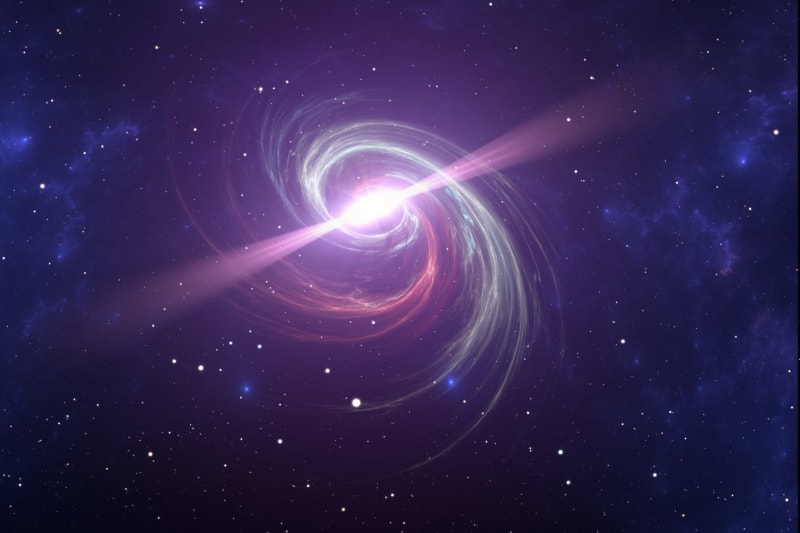
What he found was extraordinary. GRB 250314A came from a rare type of gamma-ray burst created when a massive star's core collapsed into a black hole. As the core imploded, it launched powerful jets of gamma rays into space while the star's outer layers exploded outward in a brilliant supernova.
The previous record holder was a supernova that exploded 1.8 billion years after the Big Bang. This new discovery beats that by over a billion years, pushing our observational limits deeper into cosmic history than ever before.
Why This Inspires
The most surprising part isn't just how far away this explosion happened. Webb's spectral analysis revealed that even in a universe only 5% its current age, massive stars were dying in ways strikingly similar to supernovas we observe today.
This means the fundamental processes that forge elements and shape galaxies were already in place at the cosmic dawn. The same stellar lifecycles that created the building blocks for planets and eventually life were operating in nearly identical ways billions of years before Earth even existed.
Every new record the Webb telescope breaks opens another chapter in our cosmic story, proving there's still so much wonder waiting to be discovered in the universe's earliest moments.
Based on reporting by Google: James Webb telescope
This story was written by BrightWire based on verified news reports.
Spread the positivity!
Share this good news with someone who needs it