Webb Telescope Spots Farthest Galaxy Ever, 280M Years Old
The James Webb Space Telescope has discovered the most distant galaxy ever detected, offering a stunning glimpse into the universe just 280 million years after the Big Bang. The find is rewriting what scientists thought they knew about how quickly stars and galaxies formed in the early universe.
Scientists just got their clearest view yet of cosmic dawn, the era when the first stars and galaxies lit up the universe, and it's completely different from what they expected.
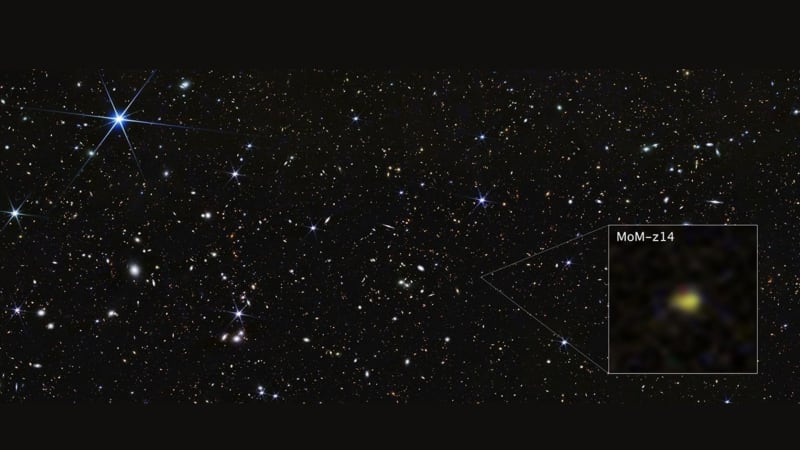
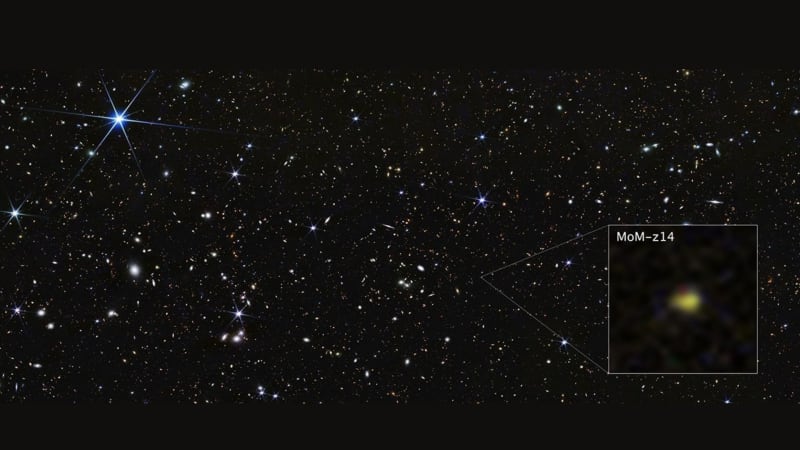
The James Webb Space Telescope has spotted galaxy MoM-z14, the most distant galaxy ever detected. Its light has traveled 13.5 billion years to reach Earth, showing us what the universe looked like just 280 million years after the Big Bang.
What makes this discovery so exciting is how much it challenges everything astronomers thought they knew. The galaxy is brighter, more compact, and more chemically developed than should be possible for such an early time in the universe's history.
"With Webb, we are able to see farther than humans ever have before, and it looks nothing like what we predicted, which is both challenging and exciting," said study lead author Rohan Naidu at MIT's Kavli Institute for Astrophysics and Space Research.
The galaxy contains surprisingly high levels of nitrogen, suggesting that massive stars formed and evolved far more rapidly than current models predict. It has also somehow cleared the primordial hydrogen gas around it, something researchers didn't think could happen so early.
Before Webb launched, scientists expected early galaxies to be small, faint, and incredibly rare. They thought detecting anything beyond what Hubble could see would require tens of hours of observations and enormous effort.
Instead, Webb has been routinely shattering expectations, capturing dozens of young galaxies from just a few hundred million years after the Big Bang. Each discovery pushes the boundaries of what seemed possible.
Why This Inspires
This isn't just about breaking records. Every time Webb reveals something unexpected about the early universe, it opens new questions and possibilities for understanding how we got here.
The telescope keeps breaking its own distance records, suggesting that even more groundbreaking discoveries are waiting to be found. Scientists are watching theories evolve in real time as observations reveal a universe far more dynamic and surprising than they imagined.
"It's an incredibly exciting time, with Webb revealing the early universe like never before and showing us how much there still is to discover," said study co-author Yijia Li of Pennsylvania State University.
The universe is turning out to be far more remarkable than we dreamed.
More Images
Based on reporting by Google News - Science
This story was written by BrightWire based on verified news reports.
Spread the positivity!
Share this good news with someone who needs it