Webb Telescope Spots Possible Planet Being Born
The James Webb Space Telescope captured stunning images of two planet-forming disks, and one may contain a newborn planet clearing its path through cosmic dust. Scientists are watching planetary birth in real time, 480 light-years away.
Scientists just captured what might be a planet in the act of being born, and the images are absolutely stunning.
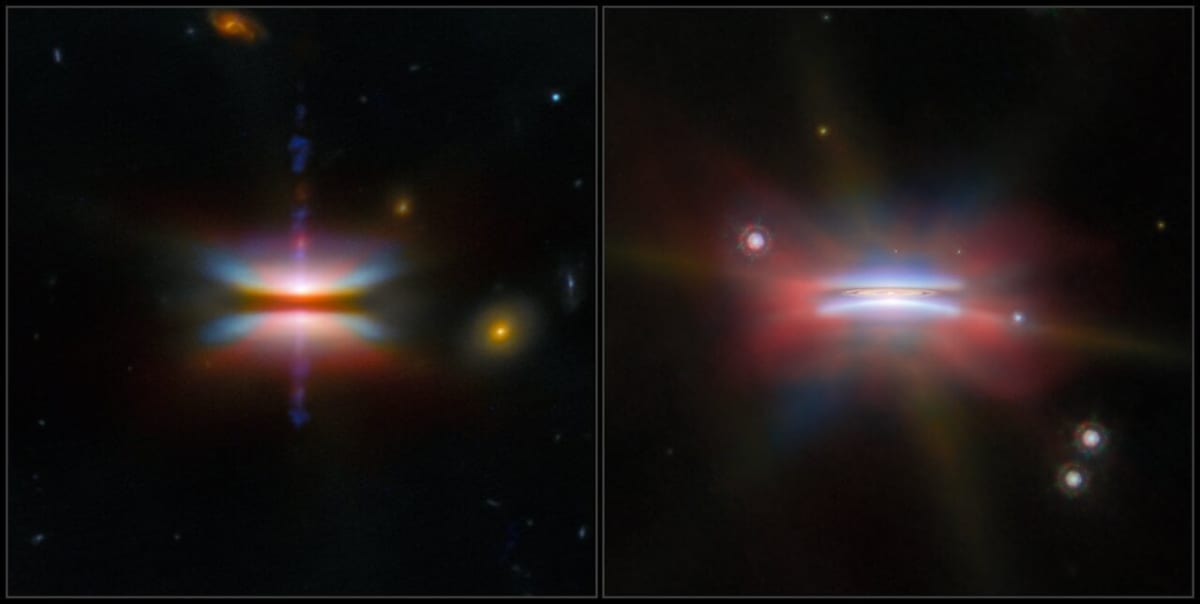
The James Webb Space Telescope photographed two protoplanetary disks, swirling clouds of gas and dust left over from star formation. These cosmic nurseries, located about 450 and 480 light-years from Earth, are where new planets take shape over millions of years.
The real excitement centers on one disk called Oph 163131. Data from the Atacama Large Millimeter Array revealed a gap in the inner disk, like a cleared lane on a dusty highway. That gap could be evidence of a forming planet sweeping up material as it orbits its young star.
The images show these disks edge-on, making the central stars nearly invisible behind clouds of cosmic material. Dust particles above and below the disk glow in reflected starlight, creating an ethereal display of reds, oranges, and greens.
Each color tells a story. Red indicates hydrogen molecules, orange reveals carbon monoxide, and green shows complex carbon compounds called polycyclic aromatic hydrocarbons. The different hues also map dust grains of varying sizes scattered throughout the disks.
Webb's powerful infrared instruments work alongside Hubble Space Telescope data to paint a complete picture. Hubble captures visible light from the central stars and fine dust, while Webb peers through the clouds to reveal what's hidden inside.
Why This Inspires
These images do more than dazzle the eye. They're giving scientists a front-row seat to processes that created our own Solar System billions of years ago.
By studying how dust settles and grains evolve in these distant disks, researchers can test their theories about how Earth and its neighboring planets formed. Every observation helps explain why some systems develop rocky planets like ours while others create gas giants.
With over 6,000 exoplanets discovered so far, astronomers need to understand the factory where they're made. These edge-on disks act like cosmic cross-sections, revealing the inner workings of planetary construction in unprecedented detail.
The observations came from Webb's first year of science operations, and they represent just the beginning of what the telescope will reveal about planet formation.
Watching new worlds take shape reminds us that creation never stops in our universe.
Based on reporting by Google: James Webb telescope
This story was written by BrightWire based on verified news reports.
Spread the positivity!
Share this good news with someone who needs it