Wild Birds Learn Human Dialects to Find Honey Together
In Mozambique, honeyguide birds learn the specific calls used by honey-hunters in different villages, adapting to local human "dialects" to maintain an ancient partnership. This remarkable flexibility helps explain how one of nature's rarest human-animal partnerships has survived across Africa for generations.
Deep in northern Mozambique's forests, wild birds are learning to speak human languages, one village at a time.
Researchers studying the ancient partnership between honey-hunters and greater honeyguide birds discovered something unexpected. The birds don't just respond to human calls. They learn the subtle differences in how each village communicates, adapting to local "dialects" the same way people do.
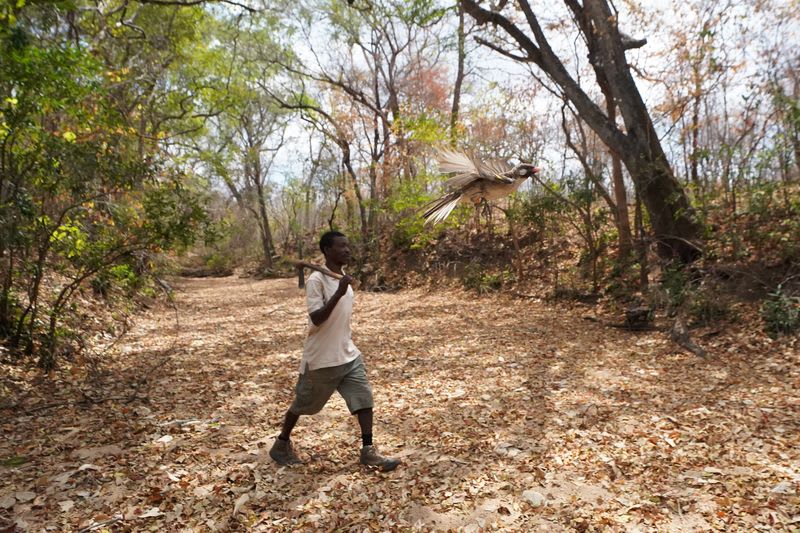
The partnership itself is already remarkable. Honeyguide birds spot bee nests from above and lead human hunters to them using specific flight patterns. The hunters then open the nests to harvest honey, leaving behind wax and larvae for the birds to eat.
In Mozambique's massive Niassa Special Reserve, honey-hunters use three distinct types of calls. Two recruitment calls grab the birds' attention, while a coordination call keeps them engaged during the hunt. These involve combinations of shrill whoops, low trills, grunts, and sometimes whistles.
Lead researcher Jessica van der Wal and her team recorded 131 honey-hunters across 13 villages. They found the calls varied between communities, with differences growing larger the farther apart villages were located.
Even more fascinating, when honey-hunters move to new villages, they adopt the local calls. "If a certain village is using a different call, it probably means that's the call to get the most honey, so why wouldn't you adapt to that?" van der Wal explained.
One hunter from Mbamba village traveled 100 kilometers to Gomba near the Tanzanian border and was surprised by the completely different calls and techniques used there. Yet the birds in each location responded perfectly to their local hunters.
This flexibility is especially impressive because honeyguides normally show bias against unfamiliar calls. The secret lies in the birds' small territorial ranges, meaning each bird only encounters hunters from one or two nearby villages with similar calls.
Why This Inspires
This discovery shows how adaptable both humans and wildlife can be when cooperation benefits everyone. The partnership has persisted across diverse regions of Africa for countless generations because both species stay flexible and keep learning.
Judith Bronstein, an ecology professor at the University of Arizona not involved in the study, called it a rare and beautiful example of human-animal mutualism. "The birds, which are very smart, quickly learn the local dialects," she said. "This makes the interaction robust to change."
The research suggests these vocal signals may continue evolving over generations, with each community developing its own unique way of talking to birds.
In a world where human-wildlife conflict often makes headlines, this ancient friendship proves that mutual respect and adaptation can create partnerships that last for thousands of years.
More Images



Based on reporting by Mongabay
This story was written by BrightWire based on verified news reports.
Spread the positivity!
Share this good news with someone who needs it