Wolves and Cougars Now Share Yellowstone Peacefully
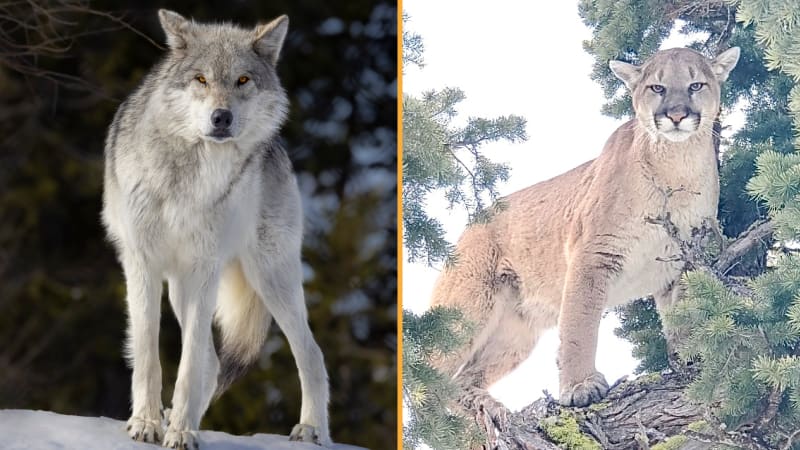
After nearly vanishing from the American West, wolves and cougars have returned to Yellowstone and learned to coexist by adapting their diets and hunting strategies. New research reveals how two apex predators can share the same territory when nature offers enough variety.
Fifty years after both species were hunted to near extinction, wolves and cougars are thriving together in Yellowstone National Park by making surprising dietary shifts that allow them to coexist peacefully.
Researchers tracked nine years of GPS data from collared wolves and cougars across Yellowstone, combined with field observations at nearly 4,000 sites. What they discovered offers hope for wildlife restoration efforts across North America.
The study found that while wolves occasionally steal prey from cougars and sometimes even kill them, cougars have adapted by hunting smaller prey instead of competing directly for large elk. Between 1998 and 2024, elk dropped from 95% to 64% of wolf diets and from 80% to 53% of cougar diets.
This dietary flexibility is key to their coexistence. When cougars kill smaller prey, wolves have less time to find and steal their kills, reducing dangerous confrontations by a factor of six compared to when cougars hunt large elk.
Wesley Binder, lead researcher and doctoral student at Oregon State University, explains that despite these one-sided interactions, cougars have shown remarkable ability to adapt. The solitary cats learned to avoid confrontations with wolf packs by changing what they hunt and where they spend their time.
Yellowstone's varied landscape provides crucial escape terrain where cougars can retreat to rocky areas that wolves avoid. This geographic diversity matters more than the total amount of prey available, the research found.
The Ripple Effect
The successful return of both predators represents something bigger than just two species learning to share space. Yellowstone now hosts the full complement of large carnivores and migratory animals that once roamed North America before extensive hunting decimated their populations.
As wolf and cougar habitats increasingly overlap throughout the western United States, understanding how these apex predators coexist provides a roadmap for conservation efforts in other regions. What works in Yellowstone could help restore ecosystems from Montana to New Mexico.
Wildlife ecologist Chris Wilmers of UC Santa Cruz calls Yellowstone "a system in flux" as recovering populations restore themselves after decades of absence. Watching these species navigate their relationships offers unprecedented insight into how nature balances itself when given the chance.
The findings suggest that successful wildlife restoration depends not just on bringing animals back, but on preserving diverse prey populations and varied terrain that allows different predators to carve out their own niches.
Nature, it turns out, has room for everyone when we protect enough of it.
More Images



Based on reporting by Live Science
This story was written by BrightWire based on verified news reports.
Spread the positivity!
Share this good news with someone who needs it