Webb Telescope Spots Galaxy From 280M Years After Big Bang
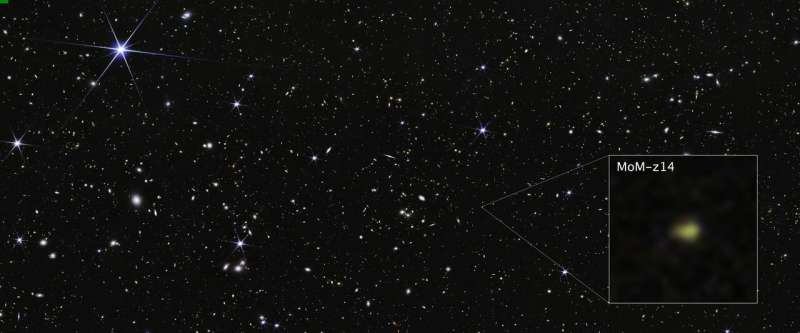
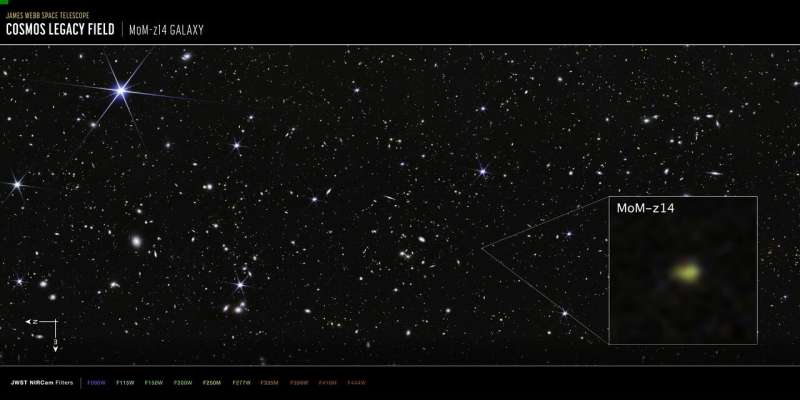
The James Webb Space Telescope just confirmed the existence of a bright galaxy that formed just 280 million years after the Big Bang, pushing our view of the universe closer to its very beginning. Scientists are amazed because these early galaxies look completely different from what theories predicted.
📺 Watch the full story above
Scientists just confirmed we can now see farther back in time than any human ever has, and what they're finding is rewriting our understanding of how the universe began.
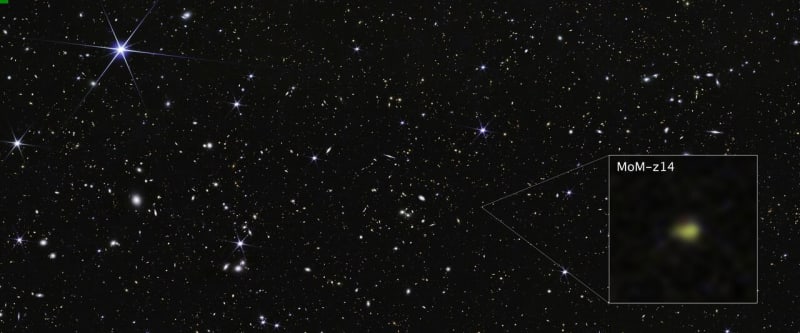
The James Webb Space Telescope has spotted a brilliant galaxy called MoM-z14 that existed when our universe was barely 280 million years old. That's just 2% of the universe's current 13.8 billion year age.
"With Webb, we are able to see farther than humans ever have before, and it looks nothing like what we predicted, which is both challenging and exciting," said Rohan Naidu, the lead researcher from MIT's Kavli Institute for Astrophysics and Space Research.
Here's what has astronomers so excited: MoM-z14 and other early galaxies like it are 100 times brighter than scientists thought possible. The early universe wasn't supposed to have enough time to form such luminous galaxies this quickly after the Big Bang.
The galaxy also contains surprisingly high levels of nitrogen, a chemical signature that typically takes many generations of stars to produce. But with only 280 million years to work with, something different must have been happening in the early universe.
One theory suggests that the dense conditions back then allowed supermassive stars to form, much larger than any stars we see today. These stellar giants could have pumped out nitrogen much faster than normal stars.
Why This Inspires
This discovery represents more than just setting records for distance. Webb is showing us that the universe's early chapters were far more dynamic and surprising than our best theories predicted.
The telescope was specifically designed to study a period called "reionization," when the first stars cleared away the thick fog of hydrogen gas that filled the early universe. MoM-z14 shows signs of creating such a clearing around itself, helping scientists map this crucial transition in cosmic history.
What makes this moment particularly special is that we're not just seeing ancient light. Scientists can compare these early galaxies with the oldest stars in our own Milky Way, which act like fossils from that same era. They're finding matching signatures, including that unusual nitrogen enrichment, confirming that Webb's observations are genuine windows into our universe's infancy.
The discovery builds on Webb's previous record when it confirmed galaxy GN-z11 from 400 million years after the Big Bang. Each new finding pushes the boundary further, and researchers say the pattern is clear: those first bright galaxies weren't flukes.
We're living in an incredibly exciting time where a telescope is literally expanding the limits of what humans can see, revealing a universe that's stranger and more wonderful than we imagined.
More Images
Based on reporting by Google News - Science
This story was written by BrightWire based on verified news reports.
Spread the positivity!
Share this good news with someone who needs it