250-Million-Year-Old Egg Solves Mammal Evolution Mystery
Scientists just confirmed that our mammal ancestors laid eggs, thanks to a rare fossil preserving a curled-up embryo from 250 million years ago. The discovery explains how one tough creature survived Earth's deadliest extinction event.
A tiny fossil the size of a walnut just solved a mystery scientists have puzzled over for decades: Did the ancestors of mammals lay eggs?
The answer is yes. And the proof comes from an unlikely survivor named Lystrosaurus, a plant-eating creature that dominated Earth after the worst mass extinction event in history wiped out most life 252 million years ago.
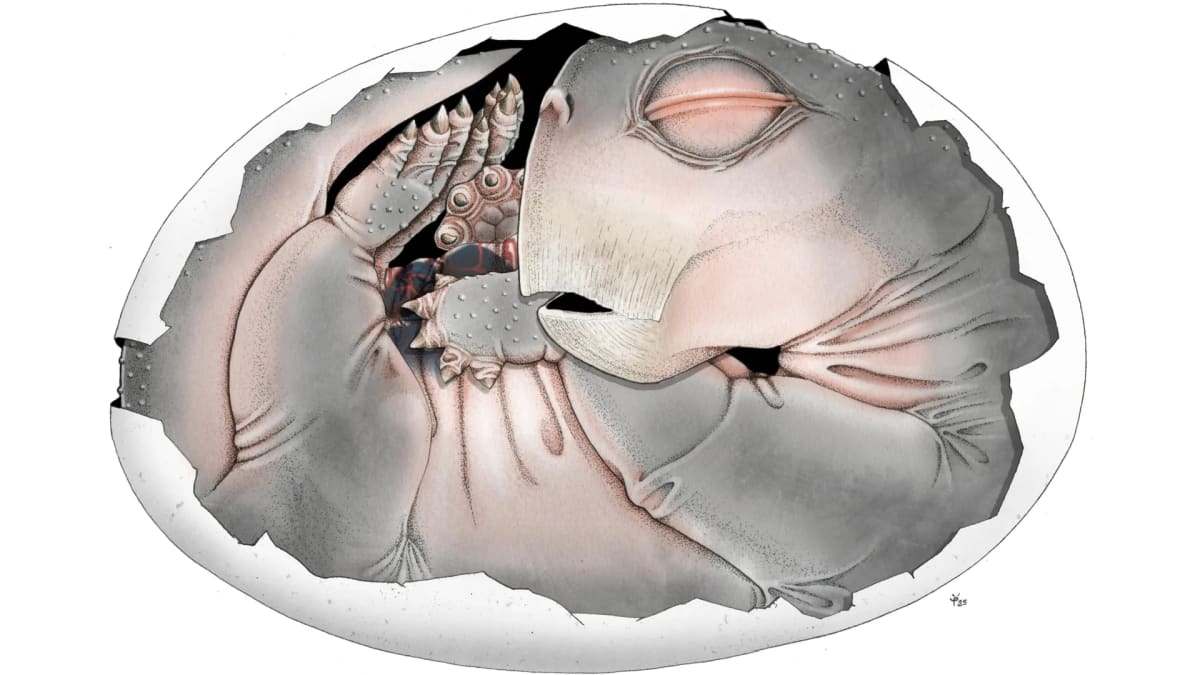
Researchers at the University of the Witwatersrand in South Africa identified the first confirmed egg from a mammal ancestor. Inside the 250-million-year-old fossil sits a perfectly curled embryo, its tiny bones preserved in remarkable detail.
The discovery started in 2008 when fossil finder John Nyaphuli spotted a small nodule during a field excursion. As he carefully prepared the specimen, tiny bone flecks emerged, revealing a Lystrosaurus hatchling frozen in time.
Professor Jennifer Botha suspected the creature had died inside its egg, but the technology to prove it didn't exist yet. Fast forward 17 years, and powerful synchrotron X-ray scanning at the European Synchrotron finally revealed what was hidden inside.
The scans showed something crucial: the embryo's lower jaw hadn't fused yet, meaning it couldn't feed itself. This detail confirmed the tiny creature never hatched.
Why This Inspires
The fossil tells a bigger story about how life bounces back from disaster. Lystrosaurus thrived in a world of extreme heat, unstable conditions, and long-lasting droughts by laying large, soft-shelled eggs packed with nutrients.
These eggs were more resistant to drying out in harsh climates. The hatchlings emerged ready to feed themselves and avoid predators, needing no parental care to survive.
This grow-fast, reproduce-early strategy worked brilliantly. While other species struggled, Lystrosaurus became one of the most common animals on Earth.
The soft-shelled eggs explain why this discovery is so rare. Unlike dinosaur eggs that mineralize and fossilize easily, soft shells usually decay before preservation can happen.
Dr. Vincent Fernandez called the moment of discovery genuinely exciting, noting that understanding reproduction in mammal ancestors has been a long-standing enigma. The fossil provides a key piece to that puzzle.
The findings reveal a pattern scientists see again and again: survival during extreme global crises depends on adaptability, resilience, and smart reproductive strategies. Lystrosaurus combined all three and won.
This ancient survivor's strategy offers hope that life finds creative ways to endure even the harshest conditions.
Based on reporting by Science Daily
This story was written by BrightWire based on verified news reports.
Spread the positivity!
Share this good news with someone who needs it