Bacteria Grow Living Electrical Wires 600M Years Before Humans
Scientists discovered aquatic bacteria that build microscopic electrical cables from nickel and sulfur, conducting electricity across distances 1,000 times their body length. The natural design mirrors modern smartphone charging cables but evolved 600 million years ago.
Nature just showed us it invented electrical wiring half a billion years before we did, and the design looks eerily like the cable charging your phone right now.
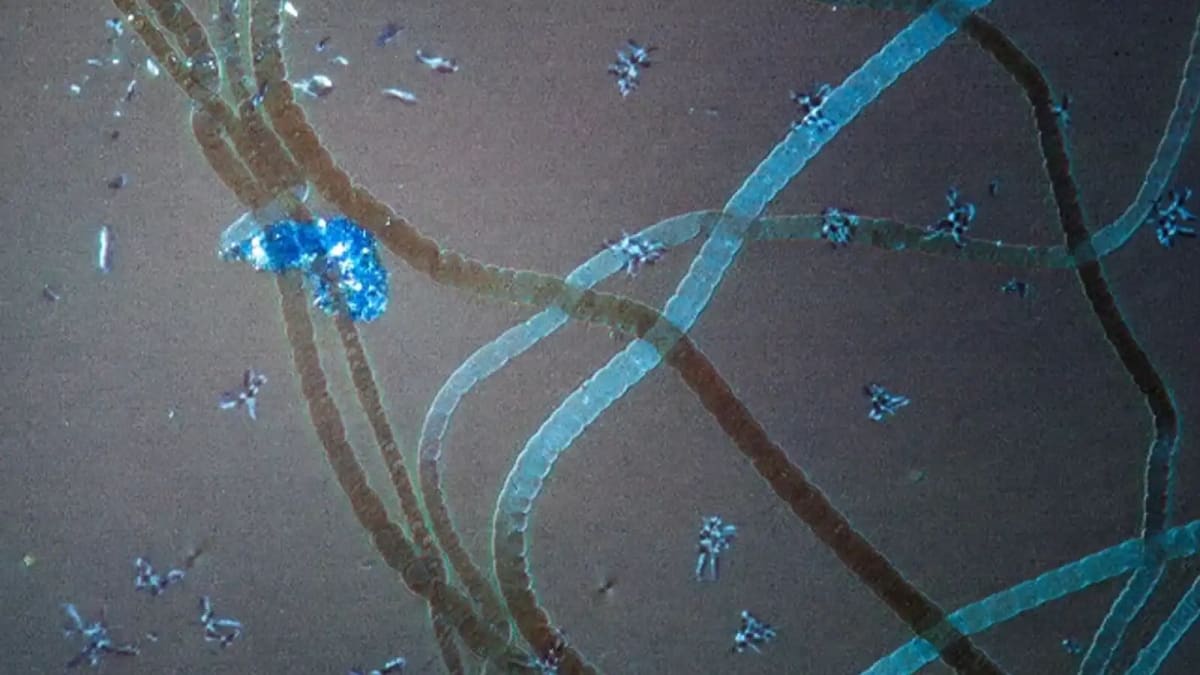
Researchers at the University of Antwerp in Belgium have discovered how strange bacteria living in underwater mud perform an extraordinary trick: conducting electricity across distances thousands of times longer than their single cells. Inside these "cable bacteria," scientists found an elaborate network of nickel-rich nanoribbons arranged into naturally grown electrical cables.
The discovery solves a biological mystery that has puzzled scientists for over a decade. These multicellular organisms live in sediment layers where oxygen-poor and oxygen-rich zones meet. Cells buried deeper harvest electrons from sulfide, while cells near the surface dispose of them in oxygen-rich water, creating an electrical current that runs between them.
Lead researcher Dr. Filip Meysman said the structure felt remarkably familiar. "It had a very familiar feeling: a braided wire consisting of thin individual wires surrounded by a protective shell layer," he told The Debrief. "This is very similar to the power cords that we use to charge our smartphones, only the cable bacterial version is 20,000 times smaller."
The comparison isn't just poetic. Molecular evidence suggests these bacteria evolved their electrical system roughly 560 million years ago, long before any human engineer dreamed up wire insulation.
Using electron microscopy and advanced spectroscopy techniques, the team found that each conductive fiber contains about 11 ultra-thin nanoribbons, each just 1.4 nanometers across. These ribbons are built from repeating nickel and sulfur complexes that stack into highly ordered electrical pathways, allowing electrons to flow smoothly rather than simply hopping between isolated points.
The braided design serves the bacteria perfectly. As they move through sediment and bend sharply, multiple intertwined ribbons provide strength, flexibility, and backup connections all at once, exactly like braided copper wire.
Why This Inspires
This discovery represents what researchers believe is the first known example of a metal-organic framework produced by a living organism. For years, chemists have designed these structures in labs for uses ranging from gas storage to electronics. Cable bacteria apparently figured it out on their own hundreds of millions of years ago.
The findings, published in Nature Communications, could give scientists a biological blueprint for creating flexible, biodegradable electronics that organisms manufacture themselves. Instead of mining rare materials and building circuits in factories, future technology might grow naturally using bacterial designs perfected over evolutionary time.
The bacteria's conductivity reaches levels comparable to materials used in electronic inks today, with some measurements hitting 500 siemens per centimeter. That's extraordinary for any biological material and proves that living systems can achieve feats we're only beginning to understand.
Evolution has been working on sustainable technology far longer than we have, and sometimes the best innovations are already growing in the mud beneath our feet.
Based on reporting by Google News - Scientists Discover
This story was written by BrightWire based on verified news reports.
Spread the positivity!
Share this good news with someone who needs it