Ghostly Star Ribbon Reveals Dark Matter's Hidden Secrets
Astronomers discovered the first stellar stream outside our galaxy, offering a groundbreaking new tool to map the universe's invisible dark matter. The faint ribbon of ancient stars is helping scientists solve one of space's greatest mysteries.
A delicate ribbon of ancient stars floating 115 million light-years from Earth just gave astronomers their first real look at how dark matter shapes distant galaxies.
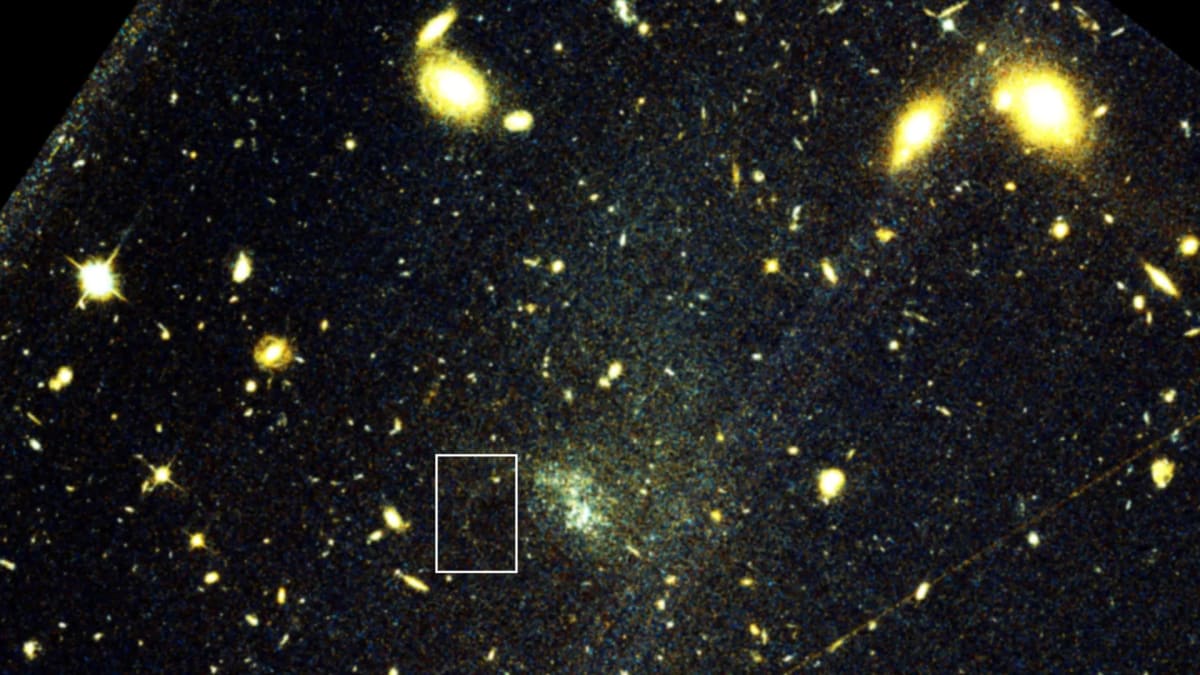
Scientists discovered the first stellar stream ever found beyond the Milky Way, a breakthrough that opens new doors to understanding the invisible substance that makes up 85% of our universe. The faint trail of stars, spotted by Northwestern University researchers using Hubble Space Telescope images, wraps around an ultra-diffuse galaxy called UGC 9050-Dw1.
These stellar streams form when a galaxy's gravity slowly pulls stars away from ancient star clusters over billions of years. The escaping stars don't scatter randomly but follow nearly identical paths, creating narrow ribbons that preserve a record of every gravitational force they've encountered.
"The stars in a stellar stream all travel along nearly the same orbit, and that orbit is shaped by the galaxy's gravity," explained Tjitske Starkenburg, a Northwestern astrophysicist who coauthored the study published in Nature. By modeling that gravity, researchers can calculate the galaxy's total mass and figure out how much comes from invisible dark matter versus visible stars.
Finding this stream was no easy feat. Dozens of similar streams exist inside our own galaxy, but they're incredibly dim and usually disappear against the bright background light of their host galaxies.
The team got lucky with UGC 9050-Dw1. Because this ultra-diffuse galaxy contains relatively few stars, it provided an unusually dark backdrop that made the ghostly stream visible for the first time.
The discovery matters beyond just spotting something new. Researchers ran thousands of computer simulations testing different dark matter distributions to see which scenarios matched the stream's actual appearance, proving this method works for investigating dark matter in galaxies beyond our own.
The results confirmed that UGC 9050-Dw1 contains massive amounts of dark matter, exactly as scientists predicted for this type of galaxy. But now astronomers have a completely new tool to verify those predictions.
The Ripple Effect
This single stream could spark a revolution in how scientists map dark matter across the universe. With this proof of concept, astronomers can now search for similar stellar streams around many different galaxy types.
A larger sample would reveal patterns in how dark matter behaves and where it concentrates throughout space. The thin streams might even show gaps or clumps where small concentrations of dark matter have disturbed the stars' paths, offering direct evidence of dark matter's structure.
What started as one researcher noticing a faint arc in archival telescope images has become a promising new window into the cosmos's greatest mystery.
Based on reporting by Science Daily
This story was written by BrightWire based on verified news reports.
Spread the positivity!
Share this good news with someone who needs it