Hubble Maps 200M Stars as Andromeda Galaxy Winds Down
Scientists using Hubble telescope data have mapped 200 million stars in the Andromeda galaxy, revealing it's peacefully winding down after a burst of star formation 2 billion years ago. The discovery offers fresh insights into how massive galaxies evolve over cosmic time.
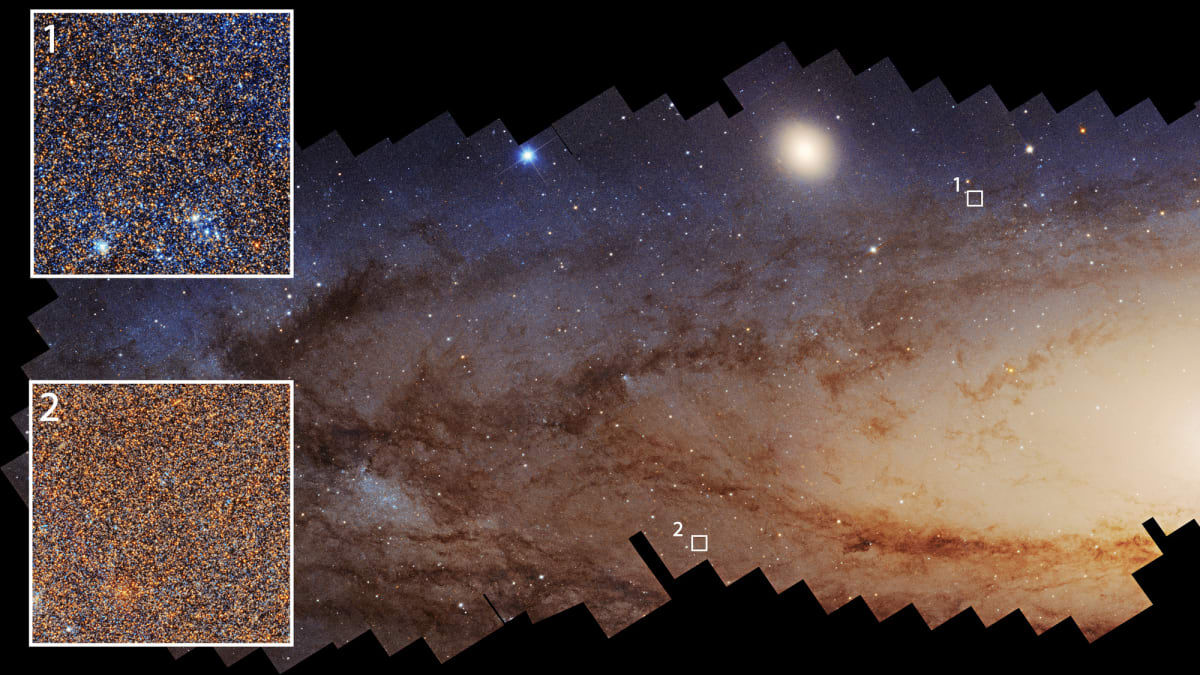
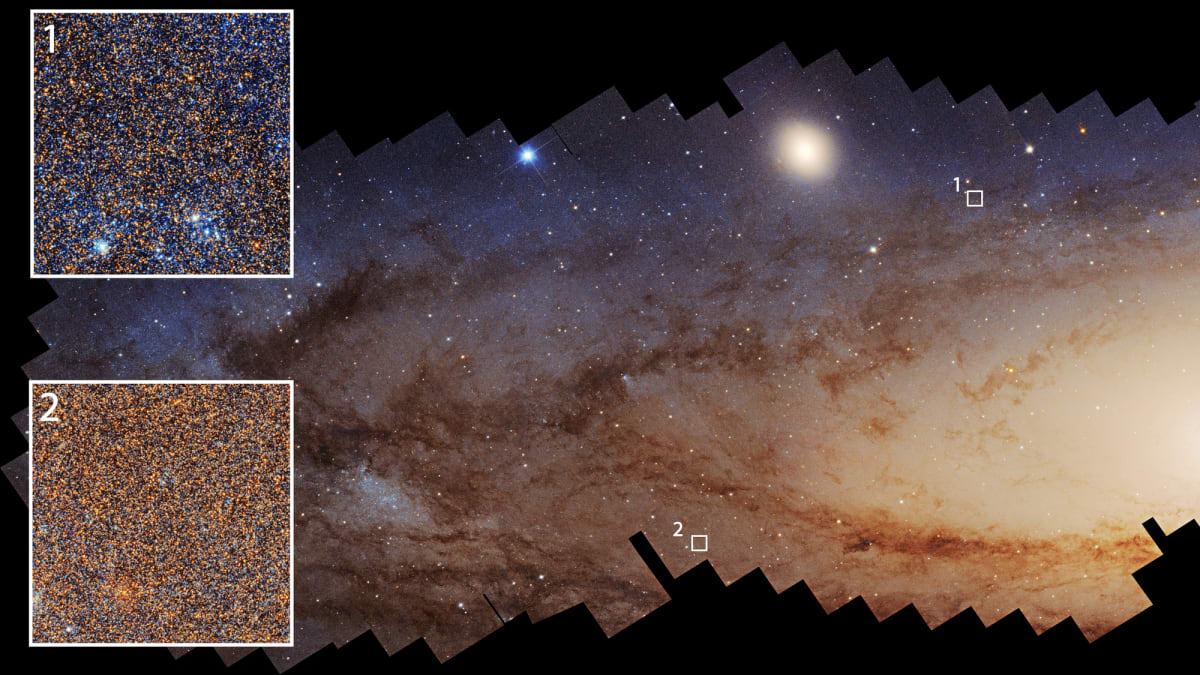
The Hubble Space Telescope has captured one of its most stunning achievements yet: a detailed map of 200 million individual stars in the Andromeda galaxy, our closest galactic neighbor.
The new study, published in The Astrophysical Journal, reveals that Andromeda is gradually calming down after an energetic period of creating new stars. About 2 billion years ago, the galaxy experienced a dramatic burst of star formation that created roughly one-fifth of all its stars, likely triggered when it merged with a smaller companion galaxy.
Scientists discovered that Andromeda's star production has steadily decreased over the past 500 million years. The galaxy was forming stars at about one solar mass per year 500 million years ago, but that rate has now dropped to just one-fifth of a solar mass annually.
The slowdown is concentrated in a ring about 32,000 light-years from the galaxy's center, where most recent star formation has occurred. Rather than suddenly running out of fuel, Andromeda appears to be naturally winding down, like a campfire fading to embers after burning bright.
Andromeda sits 2.5 million light-years from Earth and contains roughly twice the mass of our own Milky Way galaxy. It's the only major galaxy in the universe moving toward us rather than speeding away, making it an ideal laboratory for understanding how large spiral galaxies grow and change.
Why This Inspires
This cosmic detective work shows how patient observation can unlock secrets hidden in plain sight. By studying individual stars as "fossil records" of galactic history, astronomers are piecing together the life story of an entire galaxy.
The research combines two major Hubble surveys covering roughly two-thirds of Andromeda's disk. Each star captured in these images tells part of the story about when and where it formed, creating a timeline stretching back billions of years.
"Hubble is the only telescope that can give you high enough spatial resolution over a large enough area to be able to do that in Andromeda," said study co-author Ben Williams, an astronomer at the University of Washington.
The discoveries will continue as NASA's Nancy Grace Roman Space Telescope, launching as soon as August 30, takes over the investigation. With a field of view at least 100 times larger than Hubble's, Roman will survey the entire galaxy and its surrounding halo in unprecedented detail.
On November nights, you can spot Andromeda with your naked eye even from moderately light-polluted areas. In about 5 billion years, our galactic neighbor may collide with the Milky Way, though scientists are still working out its exact trajectory.
More Images

Based on reporting by Live Science
This story was written by BrightWire based on verified news reports.
Spread the positivity!
Share this good news with someone who needs it