Scientists Double Gravitational Wave Discoveries to 218
A global network of observatories just detected 128 new cosmic collisions in nine months, revealing the universe echoes with far more black hole mergers than scientists ever imagined. The discoveries include the heaviest collision ever recorded and strange new types of cosmic smash-ups.
The universe is humming with cosmic collisions, and scientists just heard twice as many as ever before.
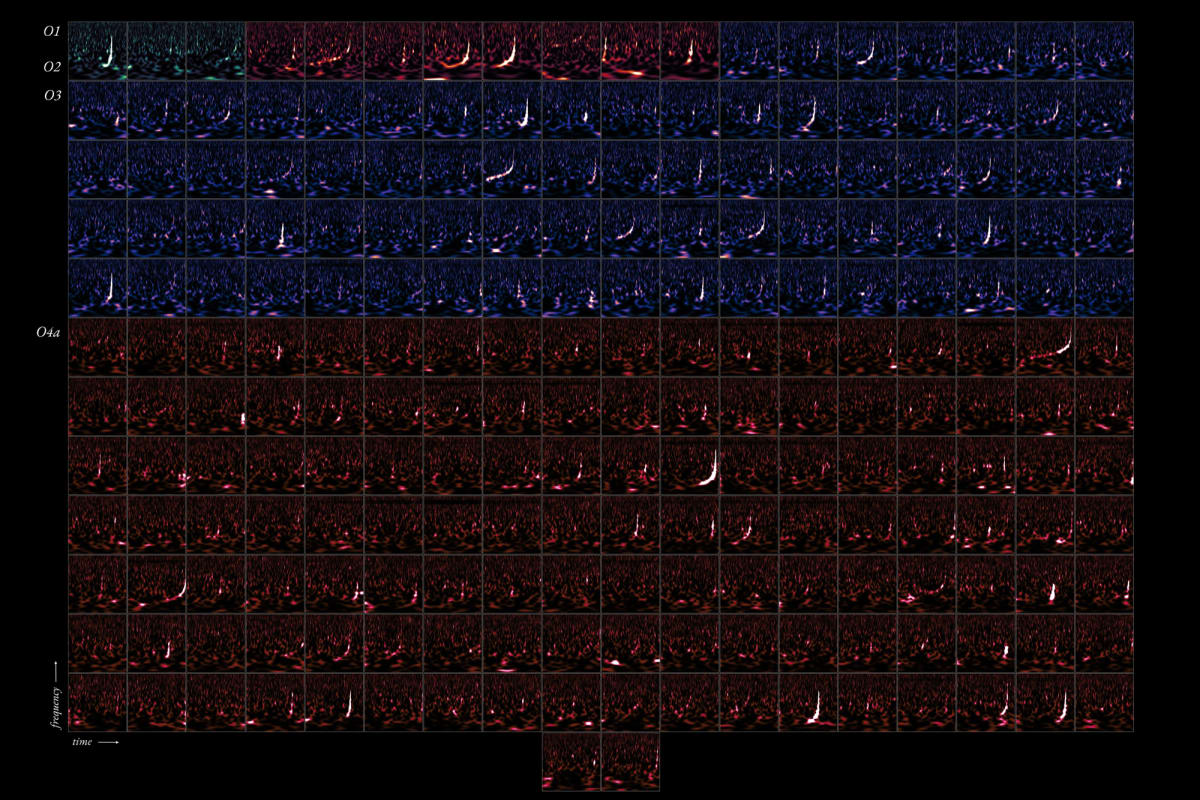
Between May 2023 and January 2024, three gravitational wave observatories detected 128 new ripples in space and time from colliding black holes and neutron stars. These signals traveled hundreds of millions of years across the universe to reach Earth, where ultra-sensitive detectors captured their faint wobbles.
The new catalog more than doubles previous detections from 90 to 218 events. What took scientists four years to find in earlier runs, they're now discovering in just nine months.
The breakthrough comes from the LIGO observatories in the United States, Italy's Virgo detector, and Japan's KAGRA facility working together. Their instruments have become so sensitive they can detect cosmic ripples that have weakened to barely a whisper by the time they pass through our planet.
"The beautiful science that we are able to do with this catalog is enabled by significant improvements in the sensitivity of the gravitational-wave detectors," says Nergis Mavalvala, dean of MIT's School of Science.
Black holes form when dying stars collapse into points so dense that not even light escapes their gravity. When two black holes spiral together, they release enormous energy as gravitational waves before merging into one larger black hole.
The latest discoveries aren't just more of the same. Scientists found the heaviest black hole merger ever recorded, pairs where one black hole dramatically outweighs the other, and systems where both black holes spin exceptionally fast.
They also captured signals from black holes colliding with neutron stars, the ultra-dense cores left behind by exploded stars. These collisions produce both gravitational waves and light, giving scientists even more information to study.
Why This Inspires
Just a decade ago, gravitational waves were purely theoretical. Einstein predicted them in 1915, but they seemed impossible to detect.
The first discovery happened in 2015, proving that scientists could hear the universe's most violent events. Now they're detecting these cosmic collisions almost weekly, transforming a single miraculous observation into an entire field of astronomy.
Each detection helps scientists understand how black holes form, how the universe evolved, and whether Einstein's theories hold up under the most extreme conditions imaginable. The catalog reveals that cosmic mergers happen far more frequently than anyone expected, painting a picture of a dynamic, active universe.
The observatories will continue their fourth run through 2025, and scientists expect hundreds more detections. What was once impossible to detect is now routine science, opening a entirely new way to explore the cosmos.
The universe has been broadcasting these signals for billions of years, and humanity is finally learning to listen.
Based on reporting by MIT News
This story was written by BrightWire based on verified news reports.
Spread the positivity!
Share this good news with someone who needs it
%2Fhttps%3A%2F%2Ftf-cmsv2-smithsonianmag-media.s3.amazonaws.com%2Ffiler_public%2F3f%2F55%2F3f5579c8-c4a7-43a5-bb54-6498478792fd%2Fhelix1940__fitmaxwzk3mcw2ntbd.jpg)