Webb Finds Black Hole Older Than Its Own Galaxy
The James Webb Space Telescope just discovered something that rewrites the cosmic rulebook: a massive black hole that existed before its galaxy finished forming. Scientists thought galaxies came first, but this tiny distant galaxy is proving them wrong.
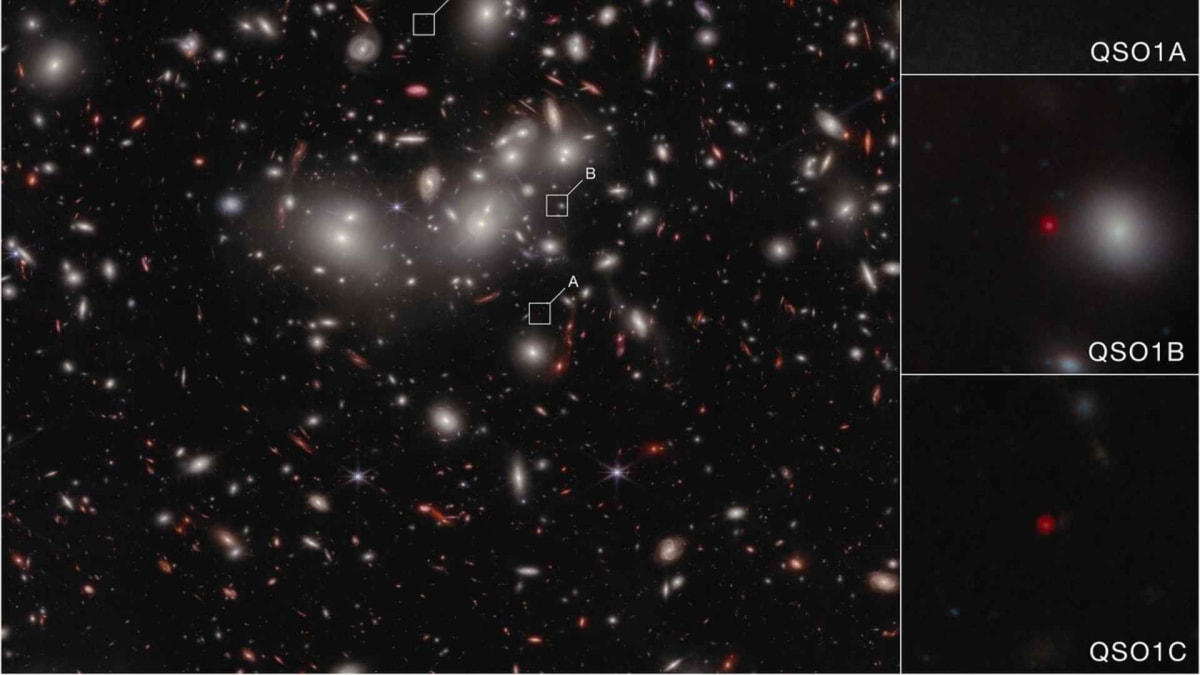
The James Webb Space Telescope just spotted something that shouldn't exist according to our understanding of the universe. A massive black hole called QSO1 appears to have formed before the galaxy it lives in even finished growing.
For decades, scientists believed the story of the cosmos went like this: stars formed first, died, and left behind small black holes that gradually merged and grew over billions of years. Galaxies came first, and black holes grew up inside them like children in a home.
Webb's discovery flips that story completely. This black hole weighs 50 million times more than our sun and accounts for two-thirds of its entire galaxy's mass. In a typical galaxy, the central black hole represents just a tiny fraction of the total mass.
Scientists confirmed the black hole's enormous size by studying the gas swirling around it. The gas orbits the black hole like planets orbit the sun, and that motion reveals how massive the object really is.
The gas itself told an even more surprising story. Most galaxies contain heavy elements like oxygen created by stars over time. But the gas around QSO1 was almost pure hydrogen and helium, the elements that existed right after the Big Bang. No stars had lived long enough to create anything heavier yet.
Why This Inspires
This discovery shows that the universe still has secrets to teach us, even about its earliest moments. The leading theory now suggests this black hole was "born big" from a massive collapse of gas shortly after the Big Bang, rather than growing slowly over time.
Webb is now searching for more of these "Little Red Dots" in the early universe to see if QSO1 is a cosmic oddity or if massive black holes regularly formed before their galaxies. Each new observation brings us closer to understanding how everything began.
The telescope that's rewriting astronomy textbooks isn't done surprising us yet.
Based on reporting by Google: James Webb telescope
This story was written by BrightWire based on verified news reports.
Spread the positivity!
Share this good news with someone who needs it