Scientists Find Bacteria's Ultimate Defense: One Tiny Protein
University of Toronto researchers discovered a single protein that both detects and destroys viruses infecting bacteria, potentially revolutionizing how we fight infections. This compact defender could help develop safer treatments for antibiotic-resistant diseases.
Scientists just found nature's minimalist masterpiece: a single bacterial protein that does the job of an entire immune system.
Researchers at the University of Toronto discovered a protein called Rip1 that can sense viral invaders and stop them in their tracks. Published in Nature, the finding reveals how bacteria protect themselves with surprising elegance.
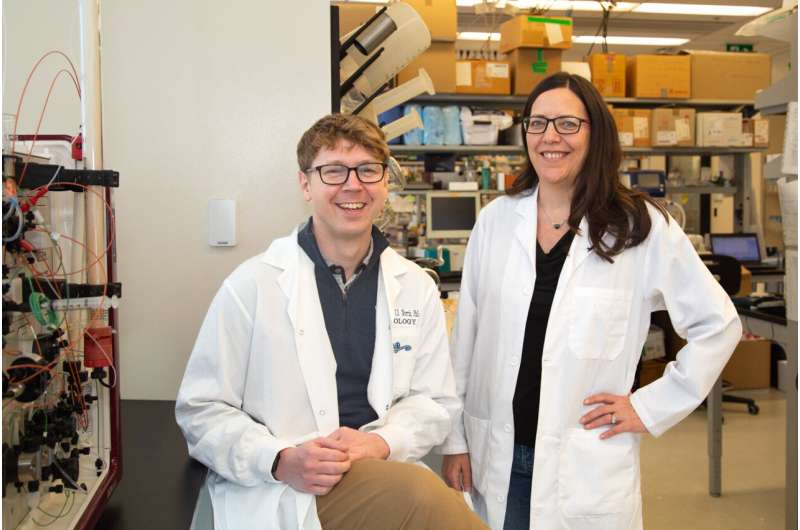
The discovery started when PhD student Pramalkumar Patel found Rip1 hiding in bacterial DNA. Working with Professor Karen Maxwell, he noticed the protein did something unusual: it protected bacteria from bacteriophages, the viruses that infect bacterial cells.
Most immune systems, including our own, use separate proteins for detection and defense. Some function as complex cellular machines requiring multiple parts. Rip1 does both jobs alone.
Here's how this tiny defender works. When no virus threatens the bacteria, Rip1 proteins stay paired up and inactive. But during an infection, Rip1 recognizes the donut-shaped structure of viral proteins trying to build new viruses.
Using those viral proteins as a template, Rip1 forms its own ring and punches straight through the bacterial membrane. The researchers used cryogenic electron microscopy to watch this happen at near-atomic resolution.
Professor Michael Norris, who studies virus assembly, explains the structure looks like two rings stacked together. A channel runs down the center, allowing the bacterial cell's contents to leak out. The bacteria dies before the virus can finish reproducing, stopping the infection from spreading.
Why This Inspires
This discovery matters beyond bacteria. Understanding how these compact defense systems work could help scientists develop new phage therapies for treating antibiotic-resistant infections.
Professor Maxwell has spent her career studying how bacteria defend themselves against viruses, hoping to harness these natural processes for medicine. Rip1 shows that evolution sometimes favors simplicity over complexity.
Assistant Professor Norris points out that viruses pack incredible functional diversity into tiny genomes. Bacteria have evolved equally compact responses. It's an ongoing arms race played out at the microscopic level, with both sides constantly innovating.
The research team found Rip1 works like a sponge, soaking up the critical viral proteins needed to build new viruses. Then it delivers the knockout punch by killing the host cell entirely.
This elegant solution proves that sometimes the best defense isn't the biggest or most complex, but the one that gets the job done efficiently.
More Images

Based on reporting by Google News - Scientists Discover
This story was written by BrightWire based on verified news reports.
Spread the positivity!
Share this good news with someone who needs it