Scientists Find 'Inside Out' Planetary System
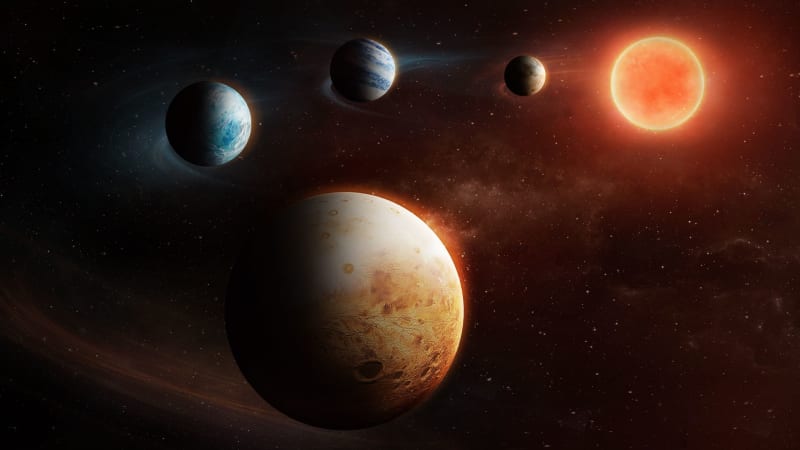
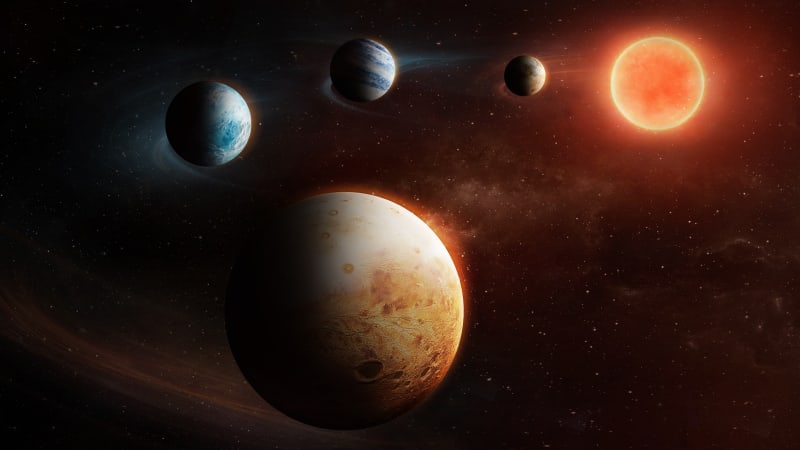
Astronomers discovered four planets orbiting a small star in a pattern never seen before: rocky, gaseous, gaseous, then rocky again. The find challenges everything scientists thought they knew about how planets form around stars.
Scientists just found a planetary system that breaks all the rules.
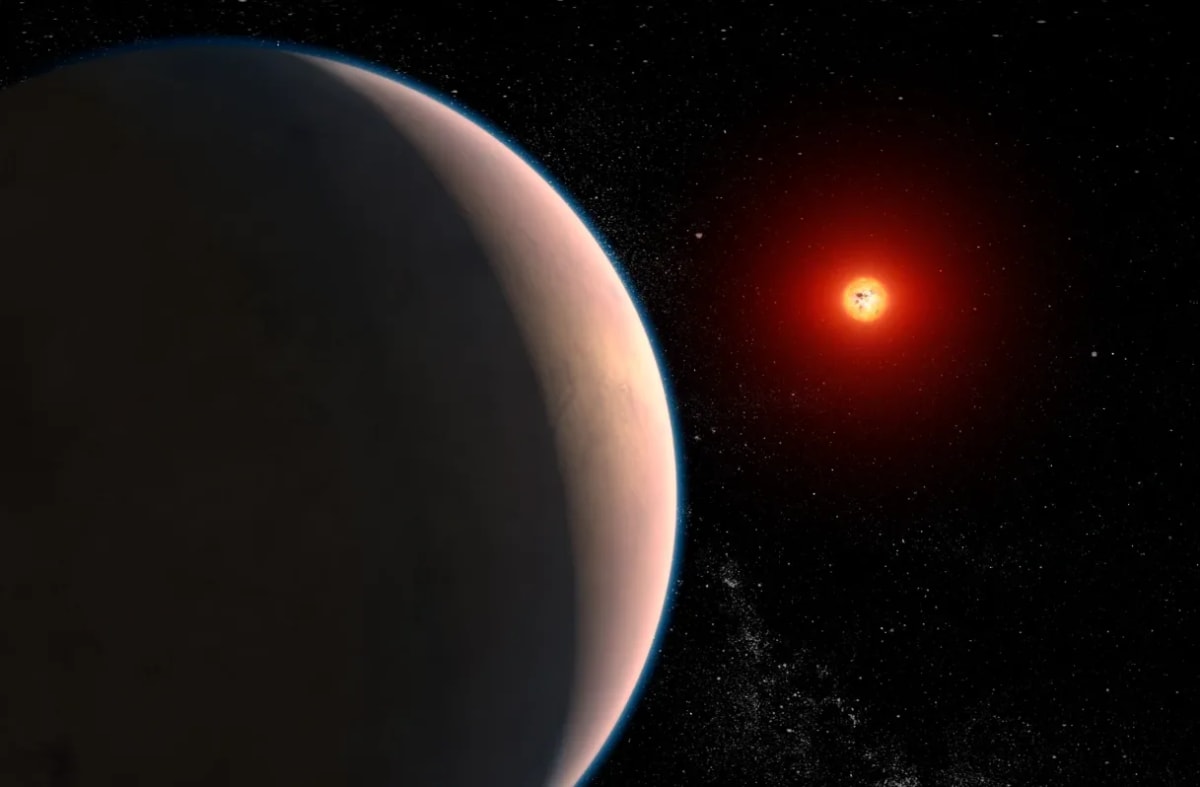
Around a small red star called LHS 1903, four planets orbit in a pattern that shouldn't exist. The lineup reads rocky, gas giant, gas giant, then rocky again at the outermost edge.
That's the opposite of what astronomers see almost everywhere else in the universe. In most systems, including our own solar system, rocky planets huddle close to their star while gas giants form farther out.
Professor Thomas Wilson from the University of Warwick calls it a "unique inside-out system." His team used telescopes from space and Earth to study all four worlds circling LHS 1903, a cool star much smaller and dimmer than our sun.
The real surprise came when they examined the fourth planet using the European Space Agency's CHEOPS satellite. Despite orbiting farther out than the two gas giants, this distant world appears small, dense, and rocky like Venus.
Rocky planets almost never form that far from their home star. Traditional science says intense radiation near a star strips away light gases, leaving behind dense cores that become rocky worlds. Meanwhile, cooler temperatures farther out let planets gather thick atmospheres of hydrogen and helium, creating gas giants.
Wilson's team checked whether the planets might have swapped positions over time or whether the outer planet lost its atmosphere in a violent collision. Neither explanation fit the evidence.
Instead, they found clues pointing to something called inside-out planet formation. In this process, planets form one by one, starting near the star. Each new planet sweeps up surrounding dust and gas as it grows, changing the environment for whatever forms next.
By the time the fourth planet was ready to form, the system may have run out of gas entirely. What emerged was a small, rocky world in a place where science said it couldn't exist.
Why This Inspires
This discovery shows that the universe still has plenty of surprises waiting for us. Planetary systems can evolve in far more diverse ways than scientists imagined just a few years ago.
Every unusual system astronomers find helps rewrite the rulebook on how worlds form. What seemed impossible yesterday becomes tomorrow's new normal, opening doors to understanding planetary systems we haven't even discovered yet.
The findings appear in the journal Science, marking the first evidence of a planet forming in a gas-depleted environment. As astronomers study more stars like LHS 1903, they expect to find other systems that challenge what we think we know about our cosmic neighborhood.
More Images

Based on reporting by Space.com
This story was written by BrightWire based on verified news reports.
Spread the positivity!
Share this good news with someone who needs it
%2Fhttps%3A%2F%2Ftf-cmsv2-smithsonianmag-media.s3.amazonaws.com%2Ffiler_public%2F3f%2F55%2F3f5579c8-c4a7-43a5-bb54-6498478792fd%2Fhelix1940__fitmaxwzk3mcw2ntbd.jpg)