Scientists Find Missing Link in How Planets Form
Astronomers discovered four "baby" planets caught in the act of transforming into the galaxy's most common type of world. The breakthrough solves a mystery about how super-Earths and sub-Neptunes take shape.
Scientists just watched planetary babies grow up, and the discovery explains how the galaxy's most common planets come to be.
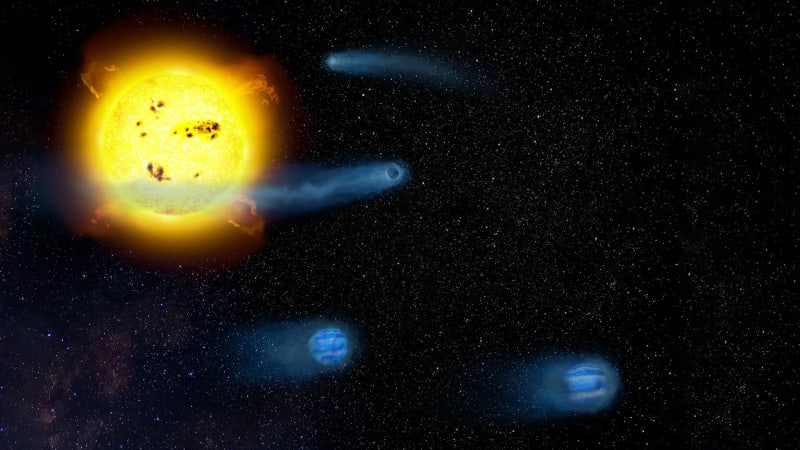
An international team of astronomers measured four extraordinarily puffy young planets orbiting a star called V1298 Tau, located about 350 light-years away. These worlds are currently as large as Neptune or Jupiter but weigh far less, making them as fluffy as cosmic cotton candy.
The star itself is just 20 million years old, a cosmic infant compared to our 4.5-billion-year-old Sun. This youth gives scientists a rare window into planetary childhood, showing how worlds evolve before settling into their adult forms.
"What's so exciting is that we're seeing a preview of what will become a very normal planetary system," says lead author John Livingston from the Astrobiology Center in Tokyo. The four planets will likely shrink into super-Earths and sub-Neptunes, the most abundant planet types in the Milky Way.
The discovery fills a crucial gap in our understanding. Astronomers know that most sun-like stars host planets between Earth and Neptune in size, orbiting closer than Mercury does in our solar system. Yet how these worlds form has remained puzzling, especially since our own solar system lacks such planets entirely.
The team spent ten years tracking the planets as they crossed in front of their star. The planets slightly tugged on each other during their orbits, causing tiny but measurable timing shifts that revealed their masses for the first time.
Measuring young planets is notoriously difficult because their stars are spotty and temperamental, making standard techniques unreliable. By watching how the planets gravitationally nudged their neighbors instead, scientists sidestepped this problem entirely.
The measurements confirmed what researchers long suspected but could never prove. Despite being five to ten times larger than Earth, the planets weigh only five to fifteen times more. This extreme puffiness means they must be losing enormous amounts of atmosphere as they age.
"These planets have already undergone a dramatic transformation, rapidly losing much of their original atmospheres," explains James Owen from Imperial College London. Over the next few billion years, they'll continue shrinking into the compact worlds we see throughout the galaxy.
The Bright Side
This discovery transforms our understanding of planetary systems from a static picture into a dynamic story of growth and change. Just as paleontologists study fossils to understand human evolution, astronomers can now watch planets evolve in real time.
The finding suggests that planetary systems go through dramatic growing pains before settling into maturity. Those countless super-Earths and sub-Neptunes detected across the galaxy weren't always so compact—they started as bloated giants that gradually transformed.
Young V1298 Tau is showing us what our galaxy looked like billions of years ago, when countless planetary systems were still finding their final forms.
Based on reporting by Science Daily
This story was written by BrightWire based on verified news reports.
Spread the positivity!
Share this good news with someone who needs it