Positive News Topic

Galaxy Research — Good News & Uplifting Stories

Read the latest positive news, breakthroughs, and inspiring stories about galaxy research, curated daily by BrightWire.

9 stories tagged with "Galaxy Research"
Black Hole 1.8 Billion Light-Years Away Unlocks Cosmic Secrets
Innovation•Jul 11

Black Hole 1.8 Billion Light-Years Away Unlocks Cosmic Secrets

A supermassive black hole in a nearby galaxy is feasting on matter just like black holes did right after the Big Bang, giving scientists an unprecedented window into the early universe. The discovery could help solve long-standing mysteries about how galaxies and black holes formed billions of years ago.

Space.com•3 min read
Webb Telescope Finds Most Ancient Galaxy Ever Seen
Innovation•Jun 19

Webb Telescope Finds Most Ancient Galaxy Ever Seen

Scientists using the James Webb Space Telescope spotted a galaxy from just 800 million years after the Big Bang, containing almost no heavy elements. It's a window into how the universe first began creating the building blocks of life.

Innovation Desk•2 min read
Manipur Scientist Names Ancient Galaxy City After Home Lake
Global News•Jun 3

Manipur Scientist Names Ancient Galaxy City After Home Lake

A 29-year-old researcher from India discovered a 12.6-billion-year-old galaxy supercluster and named it after Loktak Lake in his home state of Manipur. The cosmic structure offers new insights into how galaxies formed in the early universe.

The Better India•2 min read
Scientists Map 12 Billion Years of Galaxy's History
Innovation•Mar 24

Scientists Map 12 Billion Years of Galaxy's History

Astronomers have unlocked a new way to read a galaxy's past, tracing 12 billion years of cosmic history through chemical fingerprints in space. The breakthrough opens an entirely new field called "extragalactic archaeology" that could reveal how our own Milky Way formed.

Google News - Science•3 min read
James Webb Captures Galaxy from T. Rex Era in Stunning Detail
Innovation•Mar 13

James Webb Captures Galaxy from T. Rex Era in Stunning Detail

The James Webb Space Telescope just revealed a spiral galaxy whose light began its journey to Earth right after dinosaurs went extinct. Scientists are using this remarkably clear view to unlock secrets about how galaxies evolve across billions of years.

Innovation Desk•2 min read
James Webb Finds Record-Breaking 'Jellyfish Galaxy
Planet Wins•Mar 3

James Webb Finds Record-Breaking 'Jellyfish Galaxy

The James Webb Space Telescope spotted the most distant jellyfish galaxy ever seen, revealing that the early universe was far more violent and dynamic than scientists expected. The discovery shows galaxies were being dramatically reshaped 8.5 billion years ago.

Planet Wins Desk•3 min read
Radio Survey Maps 13.7 Million Cosmic Objects
Innovation•Feb 26

Radio Survey Maps 13.7 Million Cosmic Objects

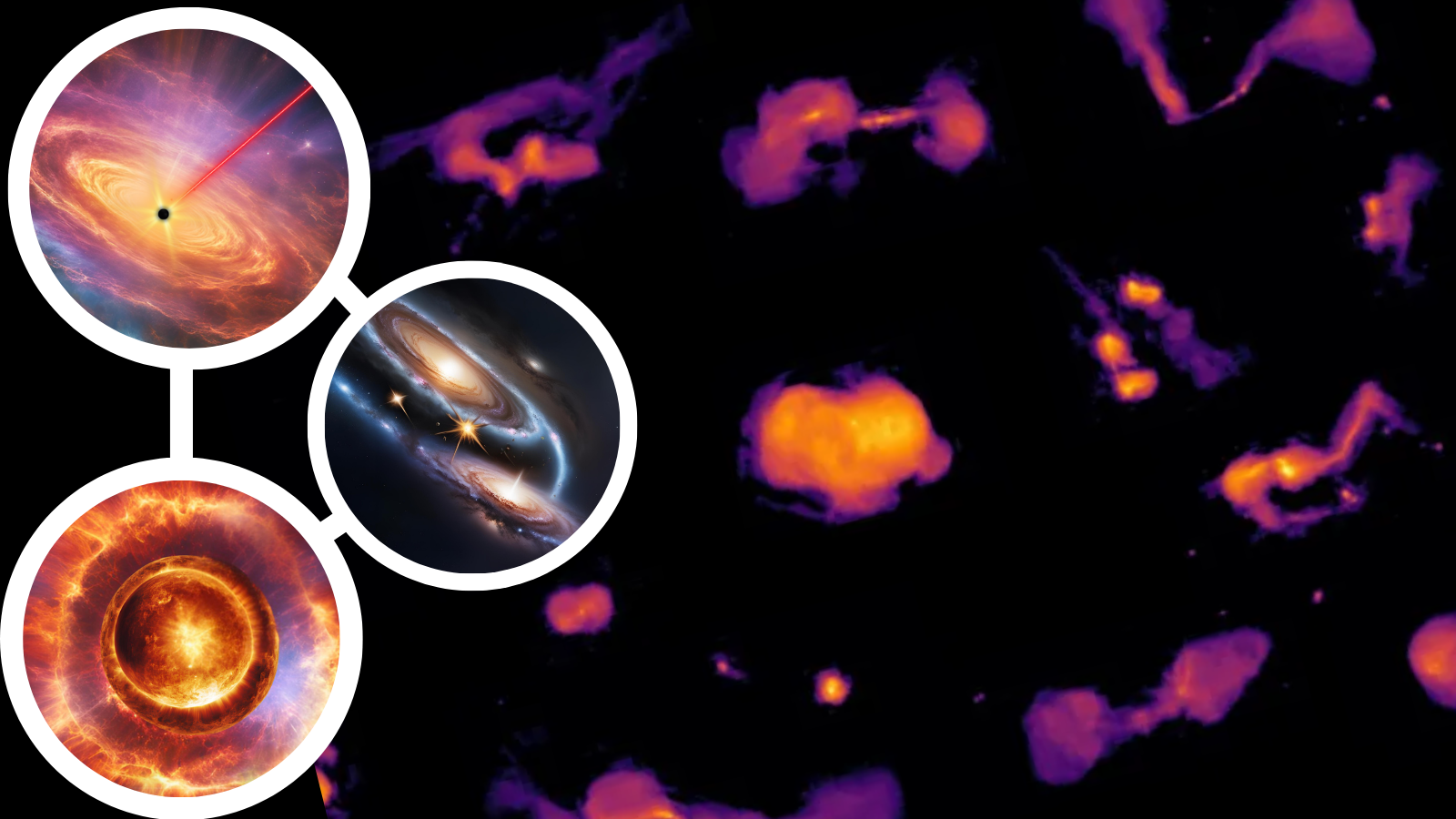
Astronomers just completed the largest radio survey of the universe ever, revealing 13.7 million previously hidden cosmic wonders including black hole jets, colliding galaxies, and exploding stars. The breakthrough could transform our understanding of how supermassive black holes shape entire galaxies.

Space.com•3 min read
Scientists Find 99% Dark Matter Galaxy Using New Method
Innovation•Feb 23

Scientists Find 99% Dark Matter Galaxy Using New Method

Astronomers discovered an almost invisible galaxy made nearly entirely of dark matter, using a clever new technique that tracks ancient star clusters instead of searching for starlight. The finding opens new doors to understanding the mysterious substance that makes up most of our universe.

Google News - Scientists Discover•3 min read
Webb Telescope Finds Galaxy Core Bursting With Carbon
Innovation•Feb 7

Webb Telescope Finds Galaxy Core Bursting With Carbon

The James Webb Space Telescope discovered an unexpectedly rich mix of carbon molecules in a distant galaxy's dusty core, including a highly reactive compound never before seen outside the Milky Way. The finding reveals that hidden galaxy centers are chemically alive, constantly breaking down and rebuilding carbon in ways scientists hadn't predicted.

Innovation Desk•2 min read